Posted on 1 Comment

Steeking Crochet Newsletter Overflow

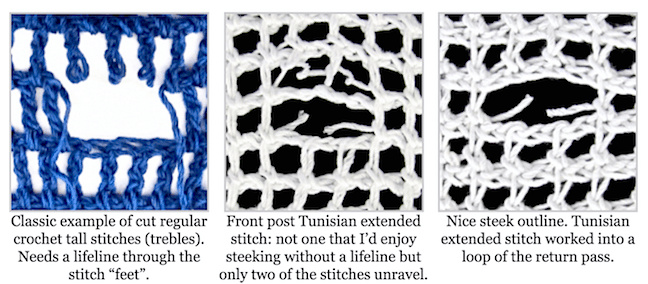
Regular treble crochet stitches, front post Tunisian stitches, and an extended Tunisian stitch pattern.
These three images didn’t make it into the newsletter I sent out yesterday on steeking crochet.

Not sure if it’s obvious in the middle photo: I removed two stitches in the forward pass. It freed up the return pass AND the stitches above them in the next row. This is because I crocheted these stitches around the post of the stitches, not into a base (i.e. into any return pass loops).

Without a lifeline, these post stitches just dissolve into messy loops. It’s not as bad as Tks or Tfs (as mentioned in the newsletter). The unraveling is contained.

My friend arrived last night from Kentucky! So glad I got the newsletter sent off. I hope you enjoyed my exploration of steeking crochet. My next critical conference prep task is to complete my last class handout (Starwirbel Way). After that milestone, I’ll add corrections to all handouts as I receive them from my editor, and direct my mental energies toward writing patterns.

Posted on

Two-Color Tunisian Crochet Swatches

One Color or Two?

Want to see some stitch patterns change when the yarn color changes?

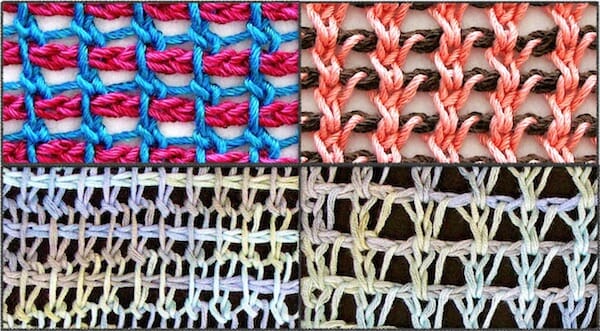
The two-color Tunisian crochet swatches are for my class handout (yes, still working on them!). I needed to clearly distinguish the forward row from the return row, so I color-coded them. I didn’t expect to like them so much! The one-yarn versions are below their two-color swatches.

Extended Tunisian stitch patterns in 2-color swatches compared with a one-yarn (softly variegated) version
Top row: two-color swatches. Bottom row: their one-yarn versions.

(Note that the one on the bottom left is a slightly different stitch pattern from the one above it. I was thinking they were the same until after I created this graphic and I don’t have a better substitute. The difference is, in the top left photo, there is an extra chain stitch in the red return row after every blue stitch. That spaces the blue stitches apart more than the stitches are in the one below it.)

Isn’t it fun to see how just alternating colors in a simple stitch pattern can give it a fresh look?

Sometimes a swatch needs to convey more than words when space is a premium (such as in a class handout). Color-coding really helps.

Progress Update

on my crochet conference readiness: only ONE class handout left to send to the tech editor! That’s FOUR down, one to go. My goal is the end of this week. Then you’ll start seeing blog posts of other topics like new Lotus yarn colors, or Charleston.

Posted on 2 Comments

Simple Tunisian Lace Nets: Day 2 of 50

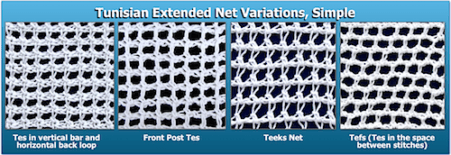
Tunisian extended stitches (Tes) crocheted into each row four different ways (Tefs, Teeks, front post etc)
Four of many simple ways to vary a Tunisian net lace.

Class Handout Progress: Steeking Tunisian Lace

The graphic above completes a section of the Steeking Tunisian Lace class handout. The base stitch is Tunisian Extended Stitch, or Tes. This chameleon-like stitch has other names and many variations (discussed in newsletter #49). It’s versatile, slightly odd, and one of my favorites, so I’m delighted to teach this class topic for the CGOA conference.

These four swatches contrast some of the simplest variations of this Tunisian lace net.

“Teeks” stands for Tunisian knit stitch extended twice. Easier to say than Tkse².

I’m also creating a graphic of fancier variations of these nets for comparison (and inspiration!). Have a look at this ripple variation! And I love these two-color versions.

I plan to pin them to my Pinterest boards like when I swatched and pinned a slew of star stitch variations a few years ago.

Posted on 5 Comments

National Crochet Month Specials

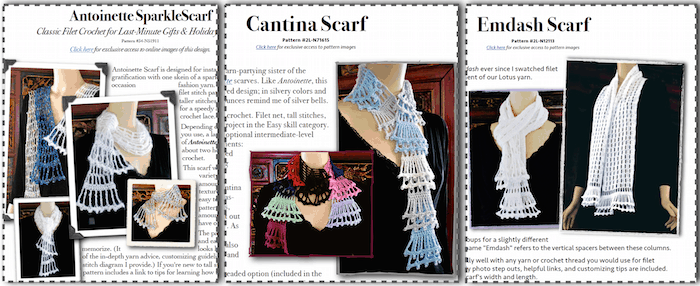
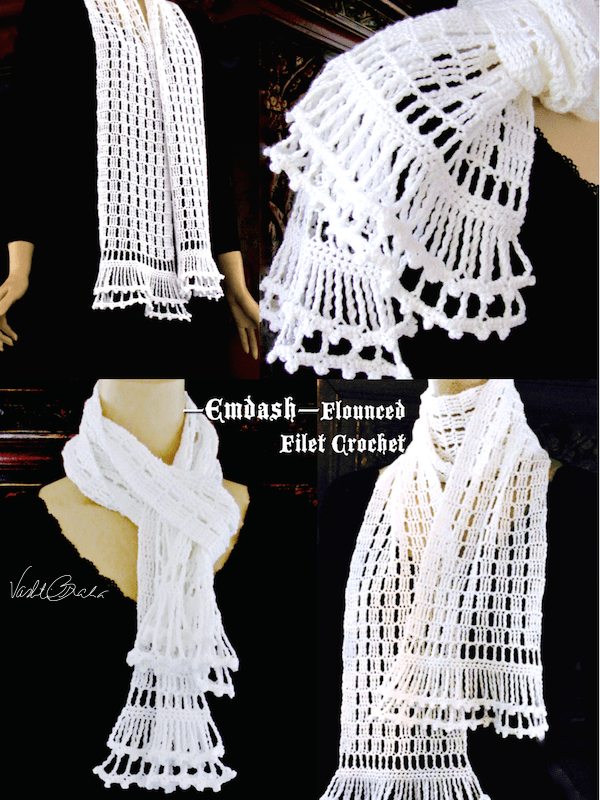
Sister filet scarves: Antoinette Sparklescarf, Emdash, and Cantina Party Flounces

Welcome, Natcromo Blog Tour Visitors!

In honor of (Inter-)National Crochet Month, I’ve added a lacy spring scarf pattern to my Ravelry shop: the double-flounced Emdash Scarf. It’s free for one week.

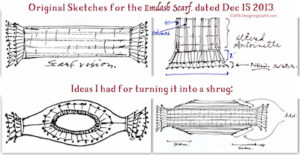
I thought I’d show you Emdash’s crochet story in pictures. National Crochet Month is for crochet stories, right? Especially about lacy spring scarves. First, the design sketches:

Emdash has two design sisters.

There they are all together at the top of this post. It’s easier to show some alternate views of them this way.  Antoinette is the eldest (I published her popular pattern in Nov. 2011). She loves lace weight metallic mohair with sequins and other holiday party yarns. Cantina is the youngest, even though her pattern was published before Emdash’s (in Dec. 2015). Cantina is a freewheeling hippie girl who likes color parties, scrap yarns, and beads.

How did Emdash get her name?

While I was exploring special characters on my keyboard, I kept seeing the scarf draped on my mannequin. The columns of tall stitches are grouped with vertical spacers. (I like the slightly different crocheting rhythm of it.) They started reminding me of emdashes, yes—a type of punctuation. It shortens so nicely to “Emmy.”

The last part of her design story is that I learned how to format and print out kit patterns with the Emdash Scarf, for the show booth I had last summer. This means Emdash is also available as a printed pattern while they last.

Happy National Crochet Month!


Emdash Scarf: Flounced Filet

I’ve had the idea for this double-flounced spring scarf ever since I swatched filet lace with the first shipment of our Lotus yarn. The name “Emdash” refers to the vertical spacers between tall stitch columns.

Our Lotus yarn of course is great for this, but the pattern works equally well with any yarn or crochet thread you would use for filet crochet. Diagrams, lovely photo step outs, helpful links, and customizing tips are included. It’s easy to change the scarf’s width and length.

Emdash has two design sisters: the fine mohair Antoinette, and the rather boho Cantina. Cantina is Emdash’s double flounce that is beaded and repeated in different colors (or scrap yarns). It started out as an eye-catching way to display Emdash in 15 Lotus colors in a show booth.

Skill Level

Easy Intermediate. This elegant filet crochet project offers Intermediate-level refinements: Special Turn, Centered stitches, and Standing stitches. The first two polish up the selvage-like row edges. Centered stitches disguise the stringy look that often develops at the tops of very tall filet stitches.

While crocheting Emdash you’ll experience:

  • How to start a new tall-stitch row without the usual gap along the edge.
  • How to give an elegant finish to super-tall stitches using Intermediate-level options.
  • How to create lacy double-layer flounces at the scarf ends.
  • How to crochet cleanly centered tall filet stitches in columns.

Finished Measurements

65″ x 7″ (165cm x 17.78cm)

Materials

  • Crochet Hook: US G6/4mm or size required for gauge. 
  • Yarn used: Designing Vashti Lotus (52% Cotton/48% Rayon; 3.5oz/100g; 256yds/235m each), 2 skeins.

To substitute a yarn, choose a #2 Fine Weight yarn with a recommended crochet hook size range of US E/4 {3.5 mm} to US G/6 {4.0 mm}. These yarns may be called Sport or Heavy Sock {Light DK, 5-Ply}. To use a thinner or thicker yarn, use a crochet hook size from the larger end of the range stated on the yarn label.