Posted on

Happy [inter-]National Crochet Month

This is my Crochetville NatCroMo blogging day.
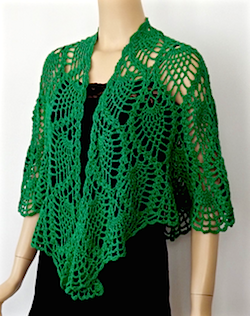
Larger wrap size of DJC Curaçao Wrap in Emerald Deep Lotus yarn
New pineapple crochet lace wrap pattern for Lotus by Doris Chan in Emerald Deep Lotus yarn.

Thanks for stopping by! It’s certainly a big weekend for us crocheters.

Tomorrow is a very green holiday (St. Patrick’s Dayso check out our DesigningVashti Lotus yarn in the new Emerald Deep color. This is a rich, satisfying, inspiring green to take you from winter to spring.

Want to feel warm and cozy quickly? 

I’ve just returned from teaching “Big-Hook Slip Stitch Crochet” in icy Chicago. I urge everyone to gather up their jumbo crochet hooks and super bulky yarns! Some of my slip stitch projects take only an hour or two this way.

Expedient Cowl Took Only Two Hours to Make.
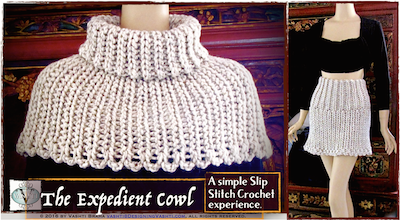
Beginner slip stitch crochet with a big hook!
Cozy Expedient Cowl: Use beginner slip stitches and a big hook. (Add a third ball and more rows for a trendy skirt!)

Warm up a big hook (size P/11.5 or 12 mm) for this toasty, speedy item. I named it “Expedient” because it took me just two hours tops to make one during LAST year’s surprise cold snap.

No super-bulkies handy? Create your own: just crochet with multiple strands held together of whatever’s in your yarn stash.

Tip: throw in at least one strand of alpaca or angora. These fibers are four times warmer than wool. Add a yarn with a halo like mohair, or a textured novelty yarn, to fill in any gaps between stitches.

Set of 5 Big Crochet Hooks: Perfect for NatCroMo
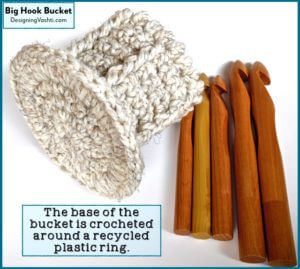
Set of 5 sizes of jumbo wood crochet hooks, and the crocheted "bucket" caddy for them showing the base that's reinforced by crocheting around a recycled plastic ring.
It’s displayed in my studio and I use it all the time now.

Be ready for the next cold snap with this set of five jumbo crochet hooks—sizes Q, R, S, T, and U—bundled with a free Big Hook Bucket pattern. (It’s already at a discount as a kit so I’m unable to discount it further for NatCroMo readers, sorry.) You can buy these crochet hooks individually here.

Armed with these hooks you’ll also be ready for when I release these new Big-Hook Slip Stitch crochet patterns (links currently go to their Ravelry project pages):

Zumie Lace Vest  I used a size S (19 mm) hook for most of it. This one-skein lace item took only 45 minutes to crochet. Yarn: the fun Hikoo Zumie by Skacel.

SS-Luscious Sampler  Size 12 mm (“P”) crochet hook and two skeins of luscious Berroco Noble.

Pink kitty-ears hat with only 95 yds and an M/9 mm hook. It’s simple back loop slip stitch in rows, then seamed on the top and side. It came out smallish on me and perfect on my friend (she kept it!). No yarn left over so I’m mulling a way to get a slightly more out of about 95 yds of yarn for this.

Slip Slab Neckwrap  It was the first prototype for the Expedient Cowl. I needed only 168 yards and a P/12 mm hook.

Also: Happy Spring Break!

Does it start this weekend for your family? My son’s starts this afternoon.
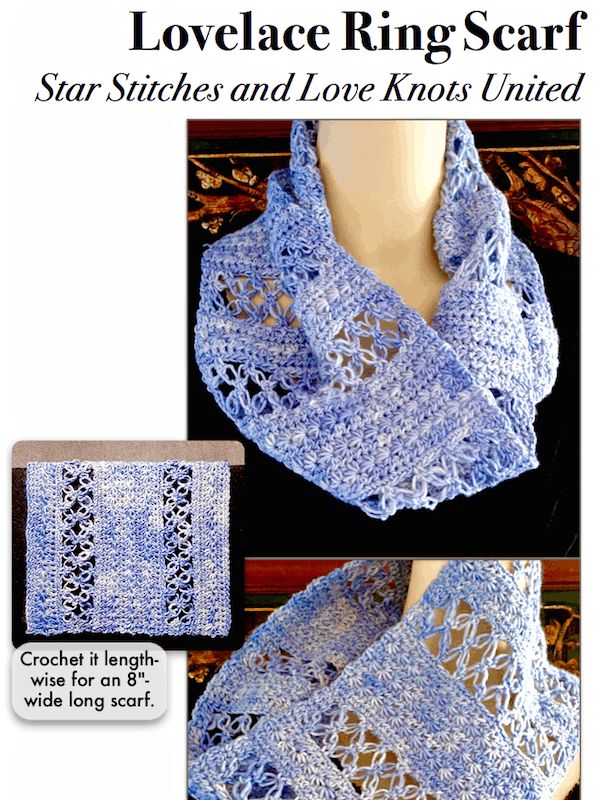
Lovelace Ring Scarf

Two romantic 19th-century crochet stitches from contrasting traditions have gracefully joined forces to warm up 21st-century necks!

I’ve used four basic crochet stitches, from slip stitch to double crochet, to smooth the way for these two unique stitches to work well together. You’ll pick up crocheting speed and never get bored.

As the laciest of the lacy stitches, love knots (aka lovers knot, Solomon’s knot) are ideal for balmy climates. Victorian-era crocheters used the finest cotton and silk threads to make fancy love knot edgings, opera bags, and baby bonnets.

Star stitches are a classic northern European stitch for crocheting thick warm coats and baby blankets in wool yarns. Even the delicate lacy stars of the earliest patterns were crocheted in lace weight wools, not cotton thread.

Pattern includes stitch hows & whys, and scarf customizing tips. The story of this special stitch pattern is blogged here.

Skill Level

Intermediate. Both star stitches and love knots are iconic Intermediate skill level stitches. In fact, the love knot has at times served to distinguish the crochet skill levels.

I teach separate three-hour classes on each of these stitch types. For this pattern I’ve selected the less challenging versions of them, and include some tips, hows, and whys that have helped my students.

You’ll have the opportunity to learn these skills:

  • How to crochet a classic two-row star stitch.
  • How to insert a two-row band of simple love knot mesh that has a selvage, and why.
  • How to customize this new stitch pattern so that you can use it for many other projects.

Finished Dimensions

One-skein scarf is 7.5″ {19 cm} wide and 30″ {76.2 cm} long (circumference of ring). Width is determined by the number of foundation chains. Add a second skein to lengthen.

Materials 

  • Crochet Hook Size G/7 {4.50 mm} or size needed for gauge.
  • Yarn usedMadelinetosh Tosh DK (100% merino wool, 225 yds/206 m per 3.5 oz/100 g), one ball of color Blue Gingham used.

Yarn substitution advice: I recommend that you use wool yarn, or a wool-like blend. A single ply type like I’ve used here shows off these stitch textures especially well. Choose a #3 Light Weight yarn with a recommended crochet hook size range of US G/7 {4.50 mm} to US I/9 {5.5 mm}. These yarns may also be called Light Worsted. 

  • Notions: Scissors. Yarn needle. Large button(s), optional.
Posted on

Conference Prep Crazy Zone

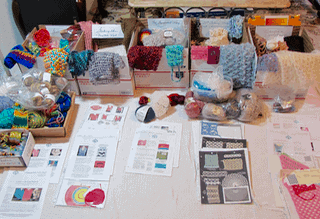
Sorting class materials into a box per class topic (total of 5) on a big white sheet.

Conference Prep Frenzy: A Two-Week Zone

For Future Vashti‘s reference: I shifted into conference prep frenzy at a specific time three days ago: end of the night on Monday, June 27th. It’s like stepping into the cockpit of an airliner, flicking on all switches and activating ‘all systems go’. (Like in the movies, anyway.) It’s obvious when it starts.

The next morning I did my teacher’s conference prep ritual: put on a pot of coffee, spread a big white sheet on the floor (because it helps me focus), lined up a row of empty boxes, and labeled each with a class topic.

Completing the Teacher’s Conference Prep

I rounded up everything to bring: first the completed designs, then the handouts, yarn and other materials for students to use, optional materials like printed patterns, key newsletter issues, visual aids like class swatches etc., topic-related teaching aids like a “blocking demo kit” for the Weightless class, and a “beading demo kit” for the love knots class.

Doesn’t it seem like with a pot of fresh coffee, one could just whip through this? The reality is that it does start this way, but my completed designs are spread all over the house and I forget about some. Not only that, each of the five class topics is distinctly different. It takes focus to keep all five in my mind at once.

It’s as if the white sheet cordons off an area of the house (and my brain) for 24-36 hours. That’s what makes it a ritual, really. I get through the first layer so that I can see the next layer.

After that time I can condense it all into 1 or 2 shipping boxes. That’s the quick and easy part.

More Show Booth Conference Prep

Here’s what else got done since I blogged 2 days ago:

  • Wound new Lotus colors in a few 100 gram balls—so that I could label and take photos of them—so that I can add them to the website. (This automatically means I committed to color names for them, too: Carbonite, Lavender Ice, Orange Luxe, and Emerald Deep.)
  • We build our booth with grid panels. Found out how hundreds of them will get to the show floor! Thanks to Linda Dean whom I can’t wait to finally see again.
  • Placed final order for crochet hooks I’ll need for the booth and classes.
  • Finalized arrangements and logistics for how everything and everybody gets there and gets back!
  • Formatted several crochet patterns for kits, classes, etc (printed):
    • a fun new one-ball pattern for Lotus that Doris designed for the booth (a printed crochet pattern). More on that later.
    • My Mesmer patterns (scarf, stole, sized vest variations on a steeky theme and with double-ended hook option) as one printed pattern set for the class, and extras for booth.
    • Did the same with my Starwirbel pattern.
    • Still have 3 more patterns to do if I can.
  • Back-&-forths with tech editor on edits of class handouts and patterns formatted for printing and kits.
  • Delegated my distress to my husband over both of our home office printers breaking within weeks of each other! He’s got that now.

?I know from last year that there will come a point when I won’t be able to focus on pattern formatting or class handouts, so I’ve done as many as possible these past few weeks.

Woke up the next morning to emails from others who were now also ‘all systems go’ with their conference prep too. And now today is Thursday June 30: twelve days from lift off. I predict these blog updates will get posted more erratically but I’ll keep trying. It forces me to find a peaceful moment to collect my thoughts.

Posted on 2 Comments

Best Crochet Conference Shoes Ever

Updated August 7, 2020. First posted June 20, 2016.

Having attended twenty-five crochet conferences in twelve years as of 2016, I’ve found that a lot depends on my weird, favorite conference shoes. Tomorrow’s post will be about the clothes, which are partly determined by the shoes.

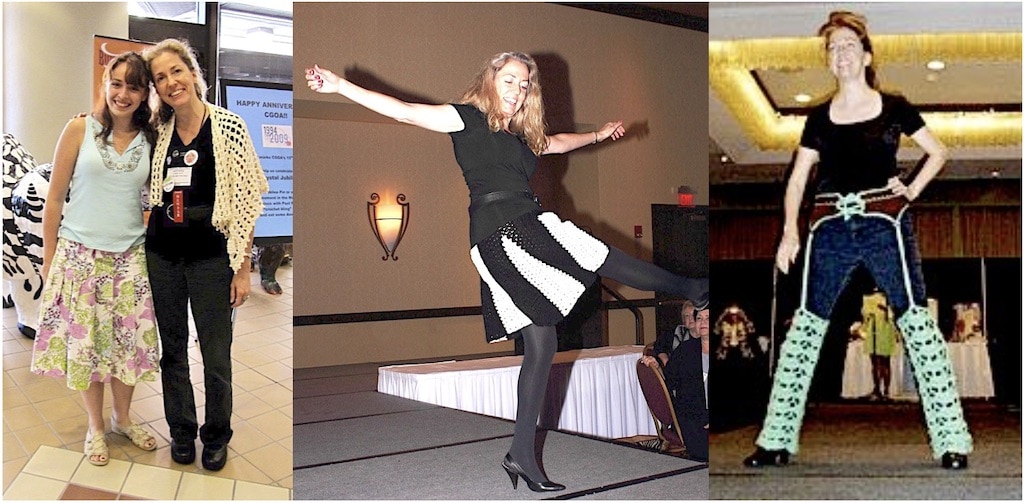
Conference shoes I've worn: Z-Coils, torture heels, sleek boots.
Left: Mary Jane Z-Coils (best picture I have of them). I remember being on my feet all day; this was the Buffalo Chain Link. Middle: painful high heels that I reserve for the banquet fashion shows. Here, I’m modeling member Urmie Seenarine’s kick-pleated skirt.
Right: Sleek boots. Pretty comfortable but a commitment! They’re big and heavy in luggage.

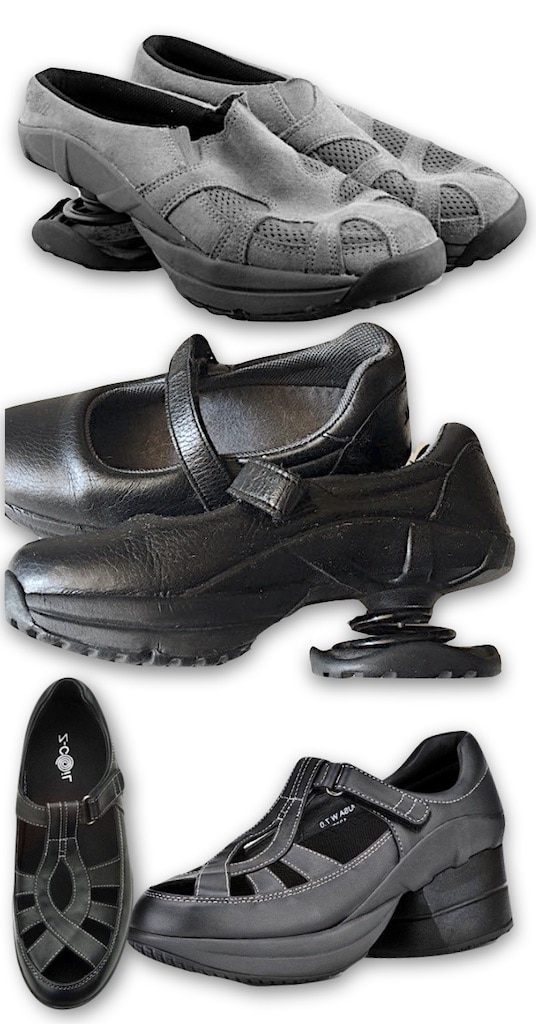
I get asked about my choice of shoes a lot. (In the future I can just refer people to this post.) I wear one ultra-comfortable pair of Z-Coils all day, and maybe fancy heels or sandals for evening. This year I’ll have a new pair of Z-Coils, the “Z-Breeze” with an enclosed heel. (That link goes to the Z-Breeze style without a cover on the heel coil. Below is how the covered heel option looks.)

I can go all out and wear sensationally uncomfortable shoes for only two hours at a time. I love fabulous-looking shoes, but I stop having fun after about two hours of wearing them if they’re uncomfortable.

Another way to say this is, I have an insane amount of fun at these conferences when I wear Z-Coils most of the time. I’m on my feet most of every day. Shoes make or break events like these.

What is this Z-Coil Sorcery?

After a month or two of wearing my first pair (the non-conference gray clog style shown below), my lower back strengthened. The shoe’s coiled heel took over the job of shock absorber. It was a revelation that my lower back had been my “shock absorber” whenever I walked on tiles and pavement, or lifted heavy things. (For other people it might be their knees, ankles, or thighs.) I could lift almost double the weight than I could before, without problems.

3 Z-Coil Styles I've owned: grey suede clog, black Mary Janes, the Z-Breeze
I wore my 1st pair, the casual gray suede clogs, around the house and fell in love. Then wore the black leather Mary Janes at conferences until they wore out. Now to do the same with the Z-Breeze (bottom).

It turns out that I have good upper body strength. It was my lower back that was limiting it.

Some people only find out about Z-Coils when they develop walking difficulties. In my case, I met a local knitter who first wore them while recovering from a knee operation. Hers looked like thick white sneakers.

She loved them so much that she continued to wear them long after. I liked how weirdly futuristic the heel looked. When I tried on a pair I was hooked! This was about ten years ago.

[Need I do a disclaimer that I’m not a doctor? Not only am I not a doctor, my lower back has never been examined by one. And while I’m disclaiming, I’m also not a representative of the Z-Coil co. and they’re not rewarding me for blogging this.]

At crochet conferences I can stand on my feet all day every day while teaching or in my market booth, and carry stuff back and forth from my hotel room to the far end of a convention center.

I can also opt to wear painful-but-pretty dress shoes in the evening, and not feel like I’m paying a price for it the next day. The Z-Coils fix that.

Long Flights

Living where I do, I’ve had to take planes to 98% of all conferences I’ve attended. I never take long flights without Z-Coils. These conference shoes come through for me even before I arrive at the event. I don’t start the conference already exhausted from carrying luggage and dashing through airports to change planes at weird hours.

By the second and third days of a conference, other people’s legs and backs are tired. They look around constantly for somewhere to sit. It’s thanks to Z-Coils that I’m looking around for a place to go dancing instead! (Doris is rolling her eyes right about now.)

[I’m adding this link to Pia Thadani’s blog post about her first time attending this conference last year. Her pointers and photos convey everything very well.]

These are significant benefits, right? Now magnify them when I don’t get enough sleep. What if I have to sleep in the airport and switch planes at 5 am? My Z-Coils “have my back”—literally. It’s such a relief to rely on their strength when travel mishaps occur.

Two Big Drawbacks

One is that I don’t feel hot in them (as in sexy). Skirts are out of the question with Z-Coils for me. Some women can make it work, but I’d always feel self conscious.

The other drawback is that Z-Coil shoes are expensive (+/- $250.) Mine have been lasting me ten years, though! Plus you can replace some parts yourself.

It’s not a big drawback when I think it through, I just get sticker shock. It’s a bargain, actually. I’m telling myself this as I prepare to buy a new pair of the best conference shoes ever.

Look at this Customized Z-Coils Pinterest board I found today!

Posted on 2 Comments

Tunisian Crochet Books for Research

At first glance, the materials I use when researching Tunisian crochet (a.k.a. afghan crochet, & including double-ended types) seem the same as for other crochet topics. Besides Tunisian crochet books and online sources that I find by Googling and searching Ravelry, I use sections of other books, notable designs, and antique sources. (Click on on of the thumbnail photos to enlarge.)

Tunisian Crochet Books are Keepers!

Over the years I’ve noticed distinctive differences in the information I can depend on for Tunisian crochet research, compared to other kinds of crochet. The most intensive research I do is for classes, but I also need to for some newsletter topics and when I’m writing a pattern for an unusual design.

100% Tunisian crochet books are special and really pretty rare. Many of them are slim, booklet-like volumes. They tend to be hard to find and to get. Some go out of print quickly, are self-published, or are only in Japanese, for example. I treasure each one. That first book stack you see is my go-to stack.

I’ve found a lot of useful information buried in general books about crochet.”TC” (Tunisian crochet) has long been presented in crochet books as a specialization. This means the TC topic sometimes gets its own thick chapter, and that’s a beautiful thing. Other times, the chapter or section is lean, but can make an important contribution somehow. It may have fresh and original material, or offer well designed instructions, stitch symbols, and other valuable publishing standards.

From my TC perspective, it makes a big, big difference when the book’s production staff, especially the technical editors and illustrators, also understand TC (not just regular crochet). It also matters what is used as a standard, because basic Tunisian crochet publishing standards are still being forged.

The book stack in the second photo shows general crochet books I own that contain TC sections I refer to often. Missing from the photo is A Treasury of Crochet Patterns by Liz Blackwell.

I’ve been thinking about this post topic ever since I did one about the very different kind of book stack I devoured for the Stitch Games class topic. (That stack was mostly written about yarn by and for knitters.) I’m also considering a post about what it has been like to unearth and use every resource I could for classes on love knots (Solomon’s knots) and star stitches over the years.