Posted on 2 Comments

Post-Creeper Crochet Ideas

My giant Minecraft-inspired crochet Creeper project gave me some more ideas. Here are a few from my studio “vault.”

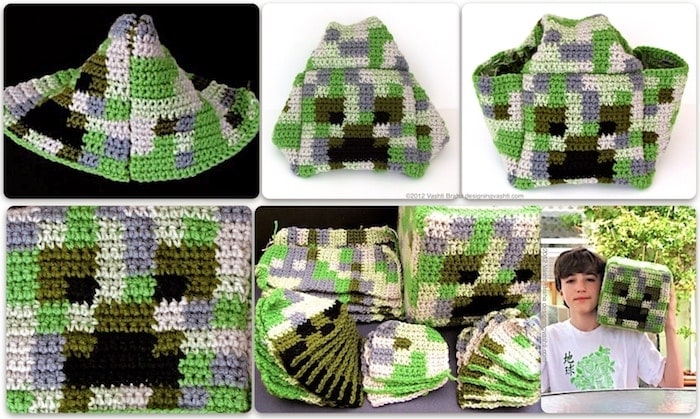
In the first three photos (top row), the head is partly assembled. On the far left I see part of a hood. For example, a muffler or wide scarf seamed at a right angle to the scarf sides to create a hooded scarf. In the middle photo I see what a Creeper backpack might look like, and in the rightmost photo, a square bottomed bucket-style tote.

Gamer crochet amigurumi: giant Minecraft Creeper
I saw other projects and uses before I finished the full-size Creeper. View full size image.

In the bottom left photo, I don’t know what YOU see but I see an ipad/laptop sleeve. I threw in the next photo so you could see what the individual pieces look like before seaming. They could be joined to create lots of useful items. Besides the obvious baby blanket, how about patches on jeans or pockets on sweaters? A bathmat might be just the way to startle awake first thing in the morning.

And finally, there’s the happy recipient in the last photo. He was 13 here. The completed Creeper head could double as a throw pillow, literally. (He threw it around a bit like he would while playing with a cubic ball in Minecraft.)

I love how big and sturdy it came out. Single crochet stitches are so versatile! (Double crochet in the UK and Australia). As with this Creeper crochet toy, it was the perfect stitch for Gallon Friend, a classroom aid for my son’s third grade teacher.

Posted on 1 Comment

Lab Experiment: I’m Customizing a Tank Top with Crochet

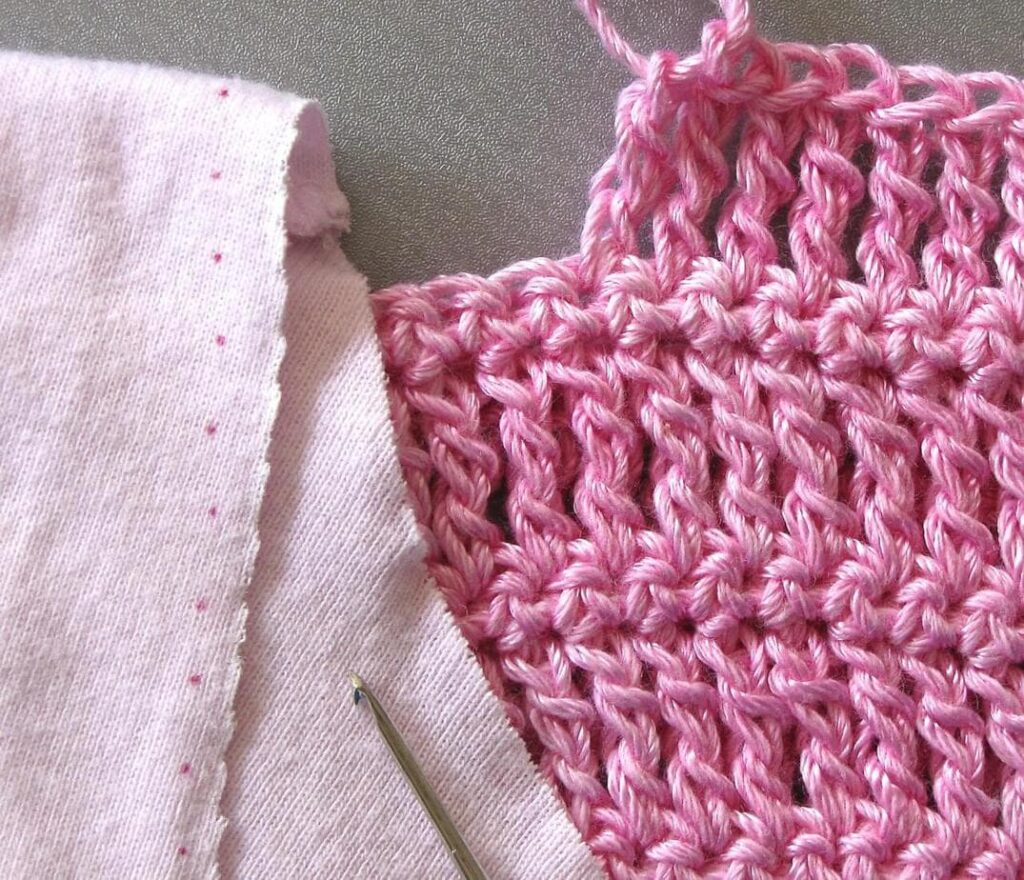
Pink Tank Top in Progress, Close Up

This is my first attempt at customizing a tank top with crochet, so I’m using a $4 scoop-neck tank top from Walmart (White Stag brand).  Update: It’s coming along well! See this followup post.

It looks dowdy on me straight off the store shelf, so I’ve drastically cropped it and turned the neckline into a deep V.

The crochet you see adds length along the bottom hem. I’m using standard sport weight yarn and a US/F (3.75 mm) crochet hook. The steel hook shown in the photo above is the largest sharp-headed crochet hook I have. I wish I had one that’s slightly bigger for pulling through loops of sport weight yarn.

The Real Reason I’m Doing This

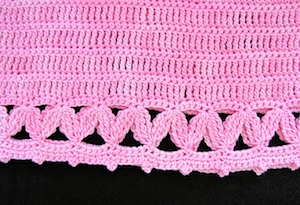
Fancy triple-treble stitch clusters in a zigzag pattern add drama to the picot hem of the peplum I added to a storebought tank top.
Crocheting the bottom hem.
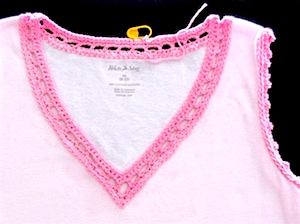
Armholes & neckline next.

What is it like to crochet DesigningVashti Lotus yarn onto t-shirt fabric? Is sport weight yarn a good match? (If I have to use lace weight yarns, I might as well just crochet the whole darn thing.) What does the texture of this yarn look like with a plain cotton machine knit fabric? 

I have mill ends of this “Pink Sugar” color; the dyeing looks more tonal than solid (not in this photo though). Do I like it? What is it generally like to pair Lotus colors with my tee shirt colors?

Can I use a super sharp crochet hook when customizing a tank top with crochet? I want to be able to start crocheting right onto fabric and get a result I like. Would I enjoy doing it more than sewing along the cut edges first? (I sealed the cut edges with an invisible permanent washable no-fray liquid.)

Customing a tank top with crochet to give it a well defined v-neck and picot-trimmed armholes.

How will it all hold up to wearing, machine washing and drying, and the Florida sun? Will the no-fray liquid add enough strength to the edges?

How will I like wearing it? Will I find I have a preference for customizing a tank top with certain kinds of crochet stitches? What if the crochet adds too much weight to the top?

Lots of what-ifs. Will I want to do something similar with my cashmere sweaters? ::gasp::

I have a few pullovers that I want to convert into cardigans. Ideally, give them a roomier fit while I’m at it. Heck, add beads. Cashmere love is a many splendored thing.

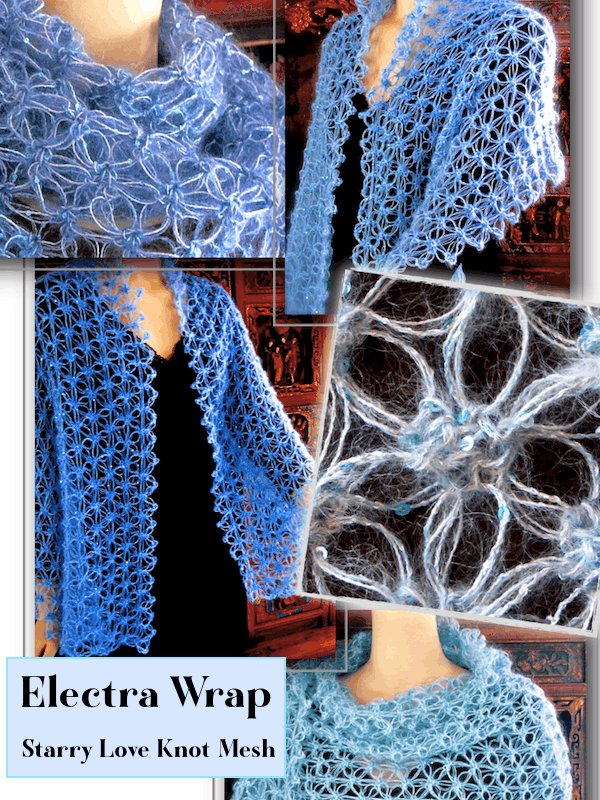
Electra Wrap

Elegant, weightless Electra Wrap is crocheted in a less common love knot mesh pattern. It’s edged with picot love knots as you go. Pictured wrap combines a fine sequined strand with one of mohair. Stitch diagram included.

I crocheted together two strands of fine celestial yarns to create this starry cloud of lover’s knot (Solomon’s knot) lace, all in one piece–no reattaching of yarn required for the picot edging. The original inspiration was a sequined Italian yarn called Crystal. Fun fact: crocheting it with a strand of fine mohair makes both yarns easier to use! 

This love knot crochet pattern is updated with a stitch diagram and more. The original edition appeared in the Summer 2013 issue of Interweave Crochet magazine. A stitch diagram essential because optical illusions are built into this design. Without a diagram, the stitch pattern is counterintuitive for some crocheters at first. Also, love knots serve as their own foundation chains and turning chains in this pattern. The yarns used contribute yet another (heavenly) illusion. 

Love knots are traditionally used to make a lacy square-holed net instead of this triangle-holed version. Please see issue #62 of my Crochet Inspirations Newsletter about this flower-like hexagonal lace structure. It’s reversible and warm because the bubble-like stitches create a lightweight web of air pockets.

Skill Level

Advanced Intermediate. The pattern may start off challenging for you until you get used to the optical illusions of this design! Instructions and links for how to crochet the love knot stitch are provided on page 3. I have written this pattern with few abbreviations. UK and Australian equivalents for American pattern terms are in brackets { }. 

View all love knot patterns here.

After using this pattern, you will know (if you didn’t already): 

  • How to crochet love knots (a.k.a. lover’s knot, Solomon’s knot, knot stitch)
  • How to understand the visual illusion of this starry type of love knot mesh.
  • How to reinforce their joining knots for this type of lace pattern.
  • How to finish the edges with picot love knots.
  • How to enjoy crocheting with fine mohair, and those tempting specialty yarns that have sequins and other notoriously tricky textures!

Finished Dimensions: 18″ {16.46 m} wide and 61″ {55.78 m} long.

Materials

  • Crochet hook: US H/8 (5 mm). Adjust hook size if necessary, see Gauge information below.
  • A stitch marker or two might come in handy.
  • Yarn needle for weaving in ends.
  • Yarns used for the project shown: 
  1. S. Charles Collezione Crystal (85% polyester, 15% cotton; 144 yd {131 m} per .88 oz {25 g}; CYC “#0 Lace Weight”): color #11, 3 skeins.
  2. S. Charles Collezione Luna (71% super kid mohair, 20% silk, 9% lurex; 232 yd {212.5 m} per .88 oz {25 g}; CYC “#0 Lace Weight”): color #25, 2 skeins.

Substituting yarns:  Choose a “#0 Lace Weight” or “#1 Super Fine Weight” yarn if you wish to crochet Electra with two strands held together. (The #0 weight category encompasses a range of yarn sizes, and mohair can make a #0 yarn appear to be a thicker #1 or #2.) Try pairing yarns that have recommended hook size ranges of 1.5 mm to 3.25 mm. 

  • If a yarn has mohair, sequins, or other fancy bumps like beads, crocheting two strands of it held together will neutralize its uneven textures. This makes it much more enjoyable to crochet with. Isn’t that a fun solution? I also find that love knots are much easier to rip out than other stitches, even when I use a mohair yarn.
  • To crochet this pattern with only one strand of a yarn, look for a “#3 Light Weight” (DK or light worsted weight) yarn. 

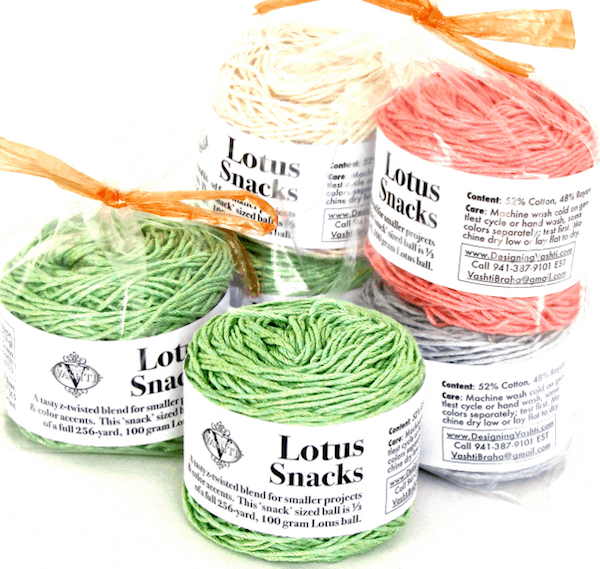
Our Lotus Yarn: ‘Snack’ size (85 yds/33g)

This is the same versatile DesigningVashti Lotus yarn in a mini ball. It’s one-third the size of a full ball. Watch Ellen Gormley crochet with Lotus in her yarn unboxing video! Explore each color in its own crochet album.

Designers Doris Chan and Vashti Braha carefully chose the Z-twisted plying and fiber blending of Lotus to optimize the crochet experience. It interacts beautifully with crochet stitches. Of course you will love knitting and weaving with it too.

Patterns & Project Ideas

For a few thousand more pattern choices (!), browse these self-updating search results in Ravelry for:

  1. Crochet only or knit only patterns that need no more than one Snack ball (85 yards of a sport weight yarn).
  2. Crochet only or knit only patterns that need no more than two Snack balls (86–170 yds of a sport weight yarn).
  3. A gallery of Lotus yarn patterns by all designers.

To find out when we add new patterns for Lotus, subscribe to the free Crochet Inspirations newsletter. Need advice about substituting Lotus for a specific crochet pattern? Visit our helpful forums in Ravelry: Doris Chan CrochetVashti’s Crochet Lounge.

How to Substitute Lotus Yarn with Your Favorite Patterns: If the crochet hook called for in the pattern is an F-5 (3.75 mm), G-6 (4.00 mm), or G-7 (4.50 mm), then look next at the type of yarn listed. If it’s primarily cotton or rayon (a.k.a. viscose, bamboo, tencel) and looks smooth, chances are great that Lotus will give you the results you’re looking for. (As for any pattern, swatch and damp block it. You’ll see its lovely drape too!)

Especially with lacy projects, Lotus may also work great with a pattern calling for an H-8 (5.00 mm) crochet hook. Doris Chan crocheted a lovely Jolimar Skirt with Lotus and an H-8 hook. (It was originally designed with the discontinued Naturallycaron Spa and an I-9/6mm hook.)

Especially with jewelry, bags, belts, and kitchen projects, Lotus Yarn works great in a tighter gauge, such as an E-4 (3.50 mm) crochet hook.

Machine wash and dry Lotus gently with like colors, although as with most fashion fabrics, hand washing and air drying will extend its life.

Symmetrical Diamond

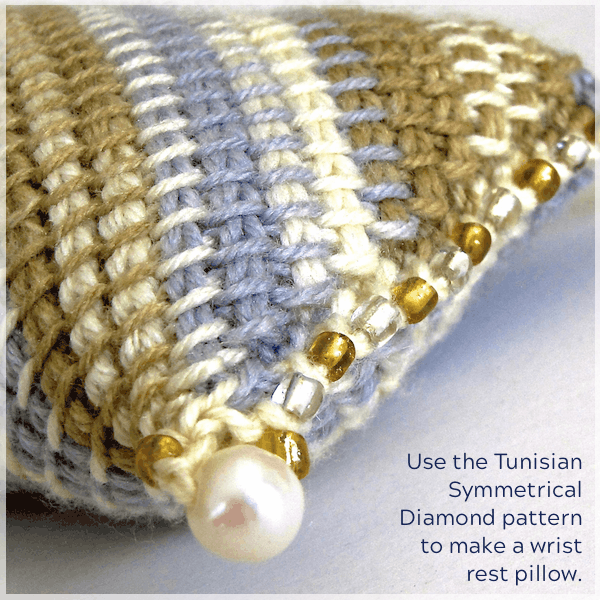
This Symmetrical Diamond pattern introduces diagonal Tunisian crochet for clothing and fashion accessories. It’s a basic pattern, so it works just as well for afghan motifs, pillows, hot pads, and other home decor. Pick a yarn with built-in color changes for exciting stripes! The pattern starts out as an all-purpose swatch for any yarn and hook size, then offers three ways to turn your swatch into a practical project:

  • Make dish cloths with medium cotton yarn.
  • Make a padded wrist rest, sleeve for your cell phone or sunglasses, or a set of reusable makeup remover pads with thinner yarns.

I developed this strategic four-edge stitch shaping combination from scratch because common shaping methods don’t work well for diagonal Tunisian crochet. My goal was to find a uniformly finished solid edge for Tunisian Simple Stitch (Tss) that’s also symmetrically stretchy. I researched 100 or so sources and I know of no one else using it; nor do I know of a published option that offers a close substitute. 

There is a Crochet Inspirations Newsletter issue about this pattern: #48 Diagonal Tunisian Crochet Discovery – http://eepurl.com/wNeCn

After you try this pattern, have a look at the new Burly Bias. I designed it for the Tunisian on the Diagonal class as the next step in having fun crocheting diagonally.  Four PeaksWarm Aeroette, and Aery Faery (rectangular wrap scarves with eyelets). Adding eyelets to each edge requires specialized tweaks for Tunisian lace; in fact, I’m discovering a new world of Tunisian edges with special effects. You might also like my other Tunisian projects that begin in one corner (Islander) or crocheted in biasing rows (Petals, Shakti Scarves).

Skill Level: Easy Intermediate

You should know how to crochet the Tunisian Simple Stitch (Tss) and have some experience using a Beginner-Level Tunisian crochet pattern. (Burly is an example of one.)

Pattern abbreviations are kept to a minimum. International English equivalents to American measurements, yarn weights, and stitch terms are in brackets { }. In response to feedback in Tunisian crochet classes, I list the stitch names and descriptions in a pink sidebar on the pattern pages. (This way there’s no need to flip back to the “Stitch Guide” page while crocheting.)

After using this pattern, you will know (if you didn’t already):

  • How to create a symmetrical triangle and a square of any size with Tunisian simple stitch by starting in the corner (and how much fun it is!).
  • How to start in one corner to add stretch, drape, and diagonal striping to Tunisian crochet.
  • How to increase and decrease along the right edge of Tunisian crochet rows to take advantage of this dynamic biasing fabric.
  • How to increase along the left edge of Tunisian crochet rows to match the drape and stretch of the right side.

Finished Dimensions

It’s easy to make your diamond larger or smaller. (That’s the “point” of corner-to-corner, really.)

  1. Dishcloth: 6.5″ {16.5 cm} square.
  2. Diamond Eyeglass Sleeve: 6″ {15.25 cm} square.
  3. Diamond Makeup Reusables: 2.75″ {7 cm} square.

Materials Used

Diamond Dishcloth

  • Crochet Hook: Size US10/J/6.0 mm Tunisian crochet hook that is at least 10″ {25.5 cm} long for the longest rows.  Tip: Since you begin in one corner, you can use a regular crochet hook as your Tunisian hook until it’s difficult for you to keep all loops of the Forward Pass (FP) on your hook; then switch to a longer Tunisian hook.
  • Two stitch markers (optional)
  • Yarn Shown: Lion Brand Cotton Ease (50% Cotton, 50% Acrylic; 207yds/189m per 3.5oz/100g ball), color #123 Seaspray. Each ball yields 4 to 6 dish cloths.

Substituting a yarn: For most dish cloths and face cloths I like a cotton-acrylic blend. It seems to stay soft longer and dry faster. Choose a #3 Light or #4 Medium Weight yarn with a recommended crochet hook size range of US7/G/4.5mm to 9/I/5.5mm. These yarns may also be called DK (Double Knitting), Light Worsted, or Worsted weight.

Diamond Eyeglass Sleeve

  • Crochet Hook: Size US8/H/5.0 mm Tunisian crochet hook that is at least 10″ {25.5 cm} long for the longest rows.  Tip: Since you begin in one corner, you can use a regular crochet hook as your Tunisian hook until it’s difficult for you to keep all loops of the Forward Pass (FP) on your hook; then switch to a longer Tunisian hook.
  • Two stitch markers (optional)
  • Yarn Shown: (75% Superwash virgin wool, 50% Nylon; 410yds/375m per 5.25oz/150g ball), color #63, approx. 41 yds {57.5 m} per Sleeve.

Substituting a yarn:  I chose a thicker than usual sock yarn for two reasons: I want this yarn to hold up when I keep this sunglass sleeve in my handbag, and it’s easy to find a dramatically self-striping sock yarn. (See Diamond Makeup Reusables below for standard thinner weight sock yarn examples.) Choose a #2 Fine Weight yarn with a recommended crochet hook size range of US4/E/3.5mm to US6/G/4.0mm. These yarns may also be called Sport, Heavy Sock {Light DK, 5-Ply}.

Diamond Makeup Reusables

  • Crochet Hook: Size US5/F/3.75 mm Tunisian crochet hook of any length.
  • Two stitch markers (optional)
  • Yarn Shown: Plymouth Sockotta (45% Cotton, 40% Superwash wool, 15% Nylon; 414yds/379m per 3.5oz/100g ball), color #6655.

Substituting a yarn:  This cotton blend sock yarn is an unconventional choice for crocheted makeup remover pads and I’m really happy with it. Many crocheters use a thicker 100% cotton “dishcloth” yarn instead (see “Diamond Dishcloth” above). Most sock yarns are designed to hold up to hard wear and machine washing and drying. I like the sock yarn I used because it’s thinner, it has enough cotton to feel soft and absorbent, and the heathered color changes don’t show any traces of makeup residue after washing. I prefer them over the one-use quilted cotton balls I’ve used for years!

Choose a #1 Super Fine Weight yarn with a recommended hook size range of US2/C/2.25mm to US4/E/3.5mm. These yarns may also be called Fingering, Sock, Light Sport, Baby {3-Ply}.

I loved this yarn for a soft and durable padded wrist rest: Schachenmayr nomotta Regia Silk Color (55% Wool, 25% Nylon, 20% Silk; 218yds/199m per 1.75oz/50g ball), color #0181. For more information about this project variation, see this Ravelry project page: http://ravel.me/vashtirama/ptdwr .

Want to see another project? I love making these double-thick Diamond Coasters with a crazy Noro yarn!