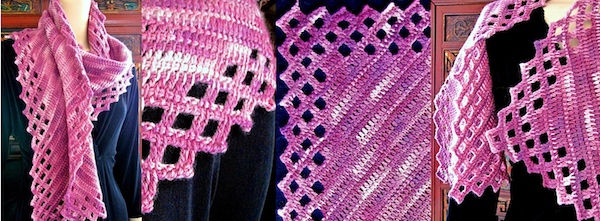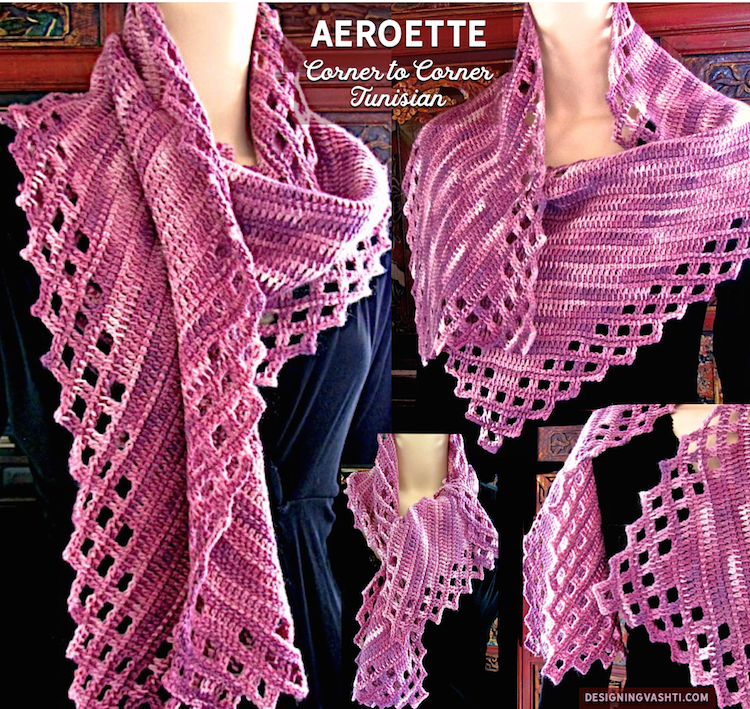
Warm Aeroette

Crocheting a rectangular scarf on the bias in Tunisian filet is rare for Tunisian crochet. Aeroette features the Tunisian foundation slip stitch increase method for this. 

Starting this scarf in one corner and finish at the opposite corner means you can easily make it wider for a wrap. Use any yarn; the special filet lace edging is crocheted as you go, and this makes it easy to predict how much yarn you’ll need to finish.

I originally designed Aeroette to be a practice pattern for a crochet class on the popular Aero WrapLike Aero, the scarf length and width are easy to adapt to the amount of yarn you have on hand.

Skill Level

Intermediate. Includes a stitch diagram and printer-friendly photo step-outs, for for lefties too. See Burly Bias (rated Advanced Beginner) and Tunisian Shakti Scarfythings (rated Easy) for good introductions to Tunisian biasing

?After using this pattern, you will know (if you didn’t already): 

  • How to start a Tunisian crochet project in one corner, build a rectangular scarf on the diagonal by increasing along the edges, and then decrease along both edges to complete it.
  • How to increase with the Tunisian Foundation Slip Stitch so that both shaped edges match.
  • How to understand this type of Tunisian crochet design in light of traditional filet crochet.
  • How to edge Tunisian crochet with lacy filet spaces as you go.
  • How to square up Tunisian filet edges with lean picots.

Finished Dimensions 

44″ x 10.5″ {111.76 x 26.67 cm} for a one-skein scarf; width and length are easily customized.

Materials

  • Tunisian Crochet Hook: Size US G/7 {4.5 mm}, minimum 10″ long, or size required for gauge.
  • Yarn: Abuelita Yarns Merino 3 Ply (100% fine imported merino wool; 420 yds {384 m} per 3.5 oz {100 g} skein): 1 skein.

To substitute a yarn of the same thickness: Choose a #1 Super Fine Weight yarn with a recommended hook size range of US C/2 {2.25 mm} to US E/4 {3.5 mm}. These yarns may also be called Fingering, Sock, Light Sport, Baby {3-Ply}. 

To substitute a thicker or thinner yarn, try a crochet hook size that is 2 to 3 sizes larger than usual for the yarn. The stitch diagram and basic pattern instructions will work for the yarn type, yarn amount, and hook size you decide to use.

Posted on 1 Comment

New Tunisian Crochet Pattern PDF: What Takes So Long?

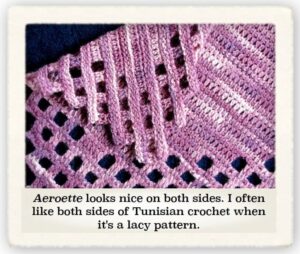
Both sides of Tunisian crochet often look nice if it's a lacier pattern.
           —-:—-
This blog post is the second part of a short series about the birth of a new crochet pattern pdf. The third is here.
Update: Downloadable PDF for the new Tunisian crochet Warm Aeroette Scarf is officially in the shop.


Behind the scenes of a new Tunisian crochet pattern

Pictured is draft #4 of Warm Aeroette Tunisian Crochet Scarf.

I’m a slow, deliberate pattern publisher.

Draft 4 of Warm Aeroette Tunisian Crochet Scarf. Almost done!

I love crocheting and so I think I chronically underestimate how much work it really is! Not only does a step almost always take longer than expected, I don’t always know when I need to recharge. (Each of these is a “step”: a stitch diagram, a photo tutorial, pattern testing, sizing, tech editing, etc.)

The Aeroette pattern has a longer title because this is a downloadable single pattern. The title needs to tell crocheters (and search engines) as much as possible in one line.

Three things can slow down new Tunisian crochet patterns for me:

Each design seems to bring unique issues!

For Aeroette, starting the scarf in one corner is a biggie. It merits a nice step by step photo tutorial. It’s a rare construction method for Tunisian crochet. Also, the best pattern wording evolves slowly sometimes. For Aeroette I’ve revised the wording of how and where the beginning and ending picots go a few times for clarity. Tunisian crochet pattern language has its own conventions.

Temptation of creative design details.

Doris is the same way and we laugh about this. Maybe optimize X, or add Y feature? What about this or that variation? I’d better swatch it in a very different yarn to make sure the design is not dependent on the yarn I’m using.

How educational it is. 

Aeroette started out originally as a practice project for a class on the Aero Tunisian Filet Lace Wrap. My goal with Aeroette is that it serve as a new Tunisian crochet skill building experience.

Sometimes I print a 2-to-a-page draft like you see here, to save paper. To save printer ink, the photos and captions are temporarily tiny. Most images are step-by-step tutorial photos that will all go on a back page. That will make printing them optional to save everyone’s printer ink.

Posted on 2 Comments

Tunisian Crochet Lace Scarf Pattern Preview

New Corner-to-corner Warm Tunisian scarf with filet border

Fresh off the hook: Warm Aeroette Lace Scarf. Just uploaded these photos. I’m very proud of it. My goal was to take the popular Aero Tunisian Wrap design, which is crocheted in fine silk, and make a warm wool version with a filet-style border. I used a fingering weight (sock weight) merino wool.

And Two More Goals

The second goal was to do a stepping-stone version of Aero. Originally, Aeroette was going to be a Tunisian crochet lace scarf pattern for a class.

It’s a simpler combination of Tunisian crochet stitches that are put together like filet crochet lace, the same way as Aero. This makes it a great way to understand a more dramatic filet-like Tunisian crochet lace scarf pattern. Like, Aero. The Ennis Wrap, also.

C2C and P2P Shapes

The third goal was to take the start-in-one-corner Aero and make it a rectangle instead of a triangle. In other words, corner-to-corner or C2C. Both Aero and Ennis are “P2P” (crocheted point to point.) I love making P2P and C2C lace shawls with Tunisian crochet! You increase steadily along one edge, then decrease steadily to end up at the far corner of the triangle.

The rectangular Aeroette is a similar crocheting experience. You start at the first of four corners (instead of three). Steadily increase, and then decrease, like with Aero and Ennis. End up at the final fourth corner and you’re done: it’s already edged!

Posted on

Tunisian Lace Crochet Pattern Test

Filet lace crochet pattern for summer top
My son and me, circa 2003. I love green and lilac together! He loved fiery tie dye.

About twelve years ago I crocheted myself a top in an easy lace crochet pattern.

It was in Sandra, a European pattern magazine. I used apple green sport weight cotton yarn from my stash. These are regular ol’ double crochet and chain stitches. See next photo below for close up view. My sparky son there in the photo with me was probably four or five years old (he’s fifteen now!).

The double crochet stitches  [abbreviated dc, or tr in the UK] are grouped into three-row blocks of six stitches each. These are alternated with lacy spaces (i.e., eight-chain bars, to use another Filet Crochet term). For a fun texture change, some of the solid blocks alternate with “blocks” of V-stitch instead. In this case, the V-stitch is [dc, chain 1, dc] in the next stitch twice. (Some V-stitches don’t have a chain-1 between the two dc; you might like this popular newsletter issue, “Unpacking V-Stitches.”)

Personally, I consider this lace crochet pattern to be based loosely on a filet crochet structure. It uses the same logic of double crochets and chain spaces. It’s easy to memorize and feels like filet crochet to me while crocheting it. I like the lacy gingham plaid effect!

Tunisian Lace Crochet Pattern vs Regular Crochet
Tunisian crochet (red), regular crochet (green)

Now for the Tunisian Lace Crochet Pattern Version.

Now compare the dark red Tunisian lace pattern swatch. I crocheted this a few months ago for my class on Tunisian Filet Crochet technique. Like the earlier green swatch, I used a sport weight cotton yarn — a test of the DesigningVashti Lotus yarn in Grenadine.

I used Tunisian double crochets (Tdc) in place of the regular dc, and Tunisian yarn overs (Tyo) in place of chains.

One interesting difference is how rope-like the Tyo bars are, compared with the chain-8 bars in green. They look a lot like very tall stitches running horizontally, don’t they? Like double treble crochet stitches, perhaps.

Another difference is how much taller the Tdc blocks are. Here’s an important thing to keep in mind, though: twelve years ago I was still making my dc stitches kind of short and compact. In other words, I used to be a “Rider.” Since then, I’ve gradually altered my crocheting style to be more of a “Lifter.” This is such an important thing to keep in mind about double crochets! If you don’t know what I’m talking about, please see this post.

Posted on

Beaded “Delta” Types of Crochet Lace

I have some fun photos of beaded crochet swatches to share: overflow from newsletter issue #62, “Delta-Type” Crochet/Hexagonal Lace Types. Click on each photo to enlarge it and see comments.

Note: I’m using “delta crochet” to refer to a category, not for a single kind of stitch pattern, and not for triangular items such as shawls. I mean geometrically a type of lace grid. In the four-sided lacy net category we have the filet type (square/rectangular spaces that stack up in columns), and the fishnet or diamond mesh type, which have diamond-shaped spaces that are offset/staggered. “Delta” is pretty well known to mean triangle, whereas a term like “isometric” might be less helpful. If you have a better term to suggest than “delta,” please leave a comment, thanks  🙂

The gist of the newsletter is: Crochet nets of three-sided triangular lacy holes (or “spaces”) have a fundamentally different kind of lace structure, or grid. You can create them with several different kinds of crochet stitches, and they all differ from nets with four-sided spaces in looks, stretch/drape properties, and the experience of crocheting them.

When I experimented with beading delta laces, interesting things happened. Adding beads to love knots is in some ways very similar to beading chain stitches. I haven’t even tried several more ways to add beads to the ones shown here. Adding beads to the classic tall-stitch delta type, though, is more limited. It would be super tricky* to add beads to a whole post of a tall stitch.

*By “super tricky” I mean unpleasant and perhaps impossible LOL.

Check back, I’m swimming in swatches and blogging them all – my goal is a short blog post most days per week. I love comments!