Crochet to the Color Playbook

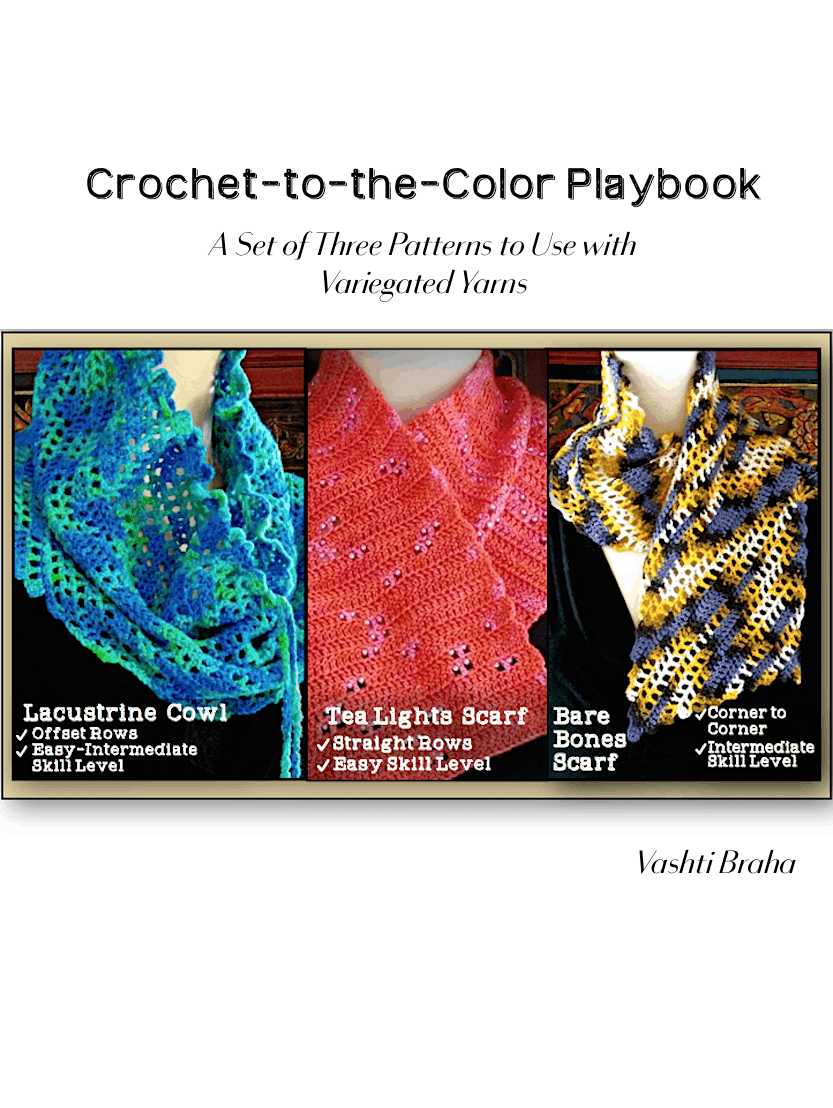
This 11-page booklet has three scarf patterns, and introduces a kind of freeform crochet that I love to use with richly hand painted yarns. This method has one-of-a-kind outcomes—like a game! All three scarf designs are self-edging and reversible.

This “stitch game” is a fun way to juggle some variables to bring out asymmetrical and startlingly edgy looks in classic crochet stitches. You get one-of-a-kind results each time you try a colorful new yarn with one of the three scarf patterns in this set:

  1. The Easy-level Tea Lights Scarf is based on the practice swatch.
  2. The Lacustrine Cowl is Easy-Intermediate because it uses offset rows.
  3. The Intermediate-level Bare Bones Scarf starts in one corner.

As the introductory playbook for the Level I stitch game, this three-pattern set uses just two basic crochet stitches and discusses game strategy with them. It includes several examples of game swatches. (The Level II playbook will add even more variables by using more stitches in new ways.)

Table of Contents 

  • How to Do the “Crochet to the Color” Method
  • Skill Levels & New Skills List, page 2
  • Yarn Selection Tips, page 3
  • The Practice Swatch & Game Strategy, pages 3-5
  • About the Three Projects in this Booklet, page 5
  • Materials Needed, page 6
  • Pattern Terms, Abbreviations, Special Stitches, page 6
  • The Patterns, pages 7-11
  • Questions & Feedback, & About Level Two, page 11

This pattern set presumes that you already know how to crochet these basic stitches: chain, single crochet {UK: double crochet}, and double crochet {UK: treble crochet}. A familiarity with filet crochet is helpful. In this booklet the color leads the crocheting instead of a filet chart. Each result is unique because each crocheter will naturally apply the game rules a bit differently.

You’ll have the opportunity to learn these skills

  • How to evaluate different kinds of variegated yarns and create new effects with them.
  • How to “crochet to the color” in traditional filet rows for a fresh randomized effect.
  • How to prevent a gap after the first double crochet of each row (single crochet method).
  • How to do the foundation double crochet, and start and end rows with increases or decreases.
  • How to crochet a scarf diagonally from one corner to the other, and customize its dimensions.
  • How to include beads in a stitch game project.
Posted on

Fascinating Crochet Texture: Chainmaille Cowl

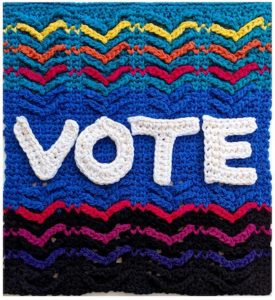
Bottom band of my Oct. 2018 VOTE crochet poster in our Lotus yarn.
This is the bottom band of a crochet poster. See the rest of it below. View full size.


Chainmaille is a downloadable DesigningVashti crochet pattern that was recently the focus of a CAL (Crochet Along) in northern Illinois. I thought you and the CAL participants would enjoy seeing a few variations I’ve swatched of this fascinating crochet texture.

The Structure of a Fascinating Crochet Fabric

Brighid's Willow afghan block contributed to a pattern booklet.
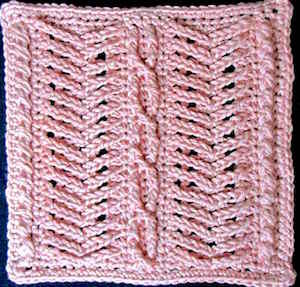
For the Brighid’s Willow afghan block I added a simple cable and contrasting edge columns.

Long chains cross over a filet surface in a herringbone-like pattern. It’s easier to see in striping colors, above and below.

It might also be easier to see in different types of yarn. The alpaca-tencel yarn adds to the scarf’s unique look. I used a cotton-acrylic blend for the afghan block at right. For the V-o-t-e poster I used two strands held together of a cotton-rayon blend.

It helps me to think of it as two layers of lace: each gives the other added dimension and visual depth. This makes it lighter to wear. It also drapes better than the solid layered and aran-style crochet fabrics.

How did Chainmaille come about?

I first saw a confusing photo of the stitch pattern in a book. I couldn’t make out what its texture was like, and the book offered no stitch diagram for it. (It turns out that a stitch diagram wouldn’t have helped me, I just had to crochet it first.) I now understand why the photo confused me: a layered crochet texture is hard to capture in a two-dimensional image. If light shows through the layers, that also adds mystery.

Tunisian crochet letters spell V-O-T-E against a rainbow aran crochet background.
This poster is approx. 12″ x 14″. Ten colors of our Lotus yarn, a cotton & rayon blend.

For me, the Chainmaille design is all about immersing oneself in a fascinating crochet fabric. There is no shaping or complicated assembly. Turning it into a cowl is simple enough: just seam it into a tube. Leave it unseamed for a neck warmer, or make it longer like I did to wear as a scarf. (Or gift to a man.)

A Chainmaille Crochet Along took place last month (July 2015) at Mosaic Yarn Studio in Mt. Prospect, Illinois. Have a look at this wrap-sized Chainmaille on display in the shop!

I met with a CAL participant, Susan Kenyon, at the Chain Link crochet conference in San Diego a few weeks ago. Susan and I seem to share the same kind of enjoyment of this fascinating crochet stitch pattern. It sounds like the CAL was fun.

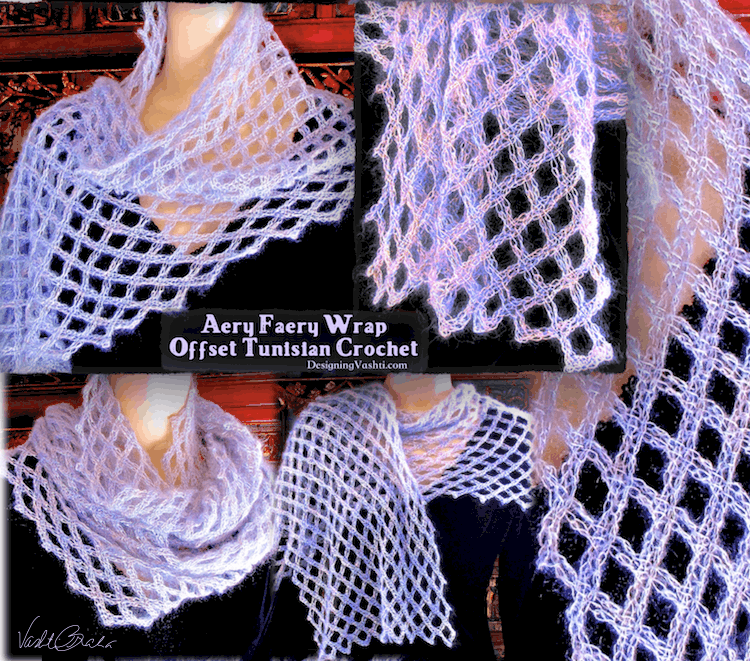
Aery Faery Offset Wrap

Included: photo step-outs and a stitch diagram for both right- and left-handed crocheters. 

The idea for Aery-Faery came from watching Once Upon a Time (a TV series based on fairy tales). I wondered if a glittering mohair and silk lace version of Aero and Warm Aeroette would be spellbinding. I proudly present Aery Faery.

Unlike Aero and Aeroette, (but like the new Diamond Ennis!), Aery Faery is not started in one corner. No increasing along the end of the Forward Pass is required. You can either seam the ends together to create a loop scarf, or steadily decrease to create scarf corners.

Skill Level

Intermediate. Here’s a list of five basic rules of Tunisian crochet patterns. Tunisian Shakti Scarfythings is rated Easy and would be a great introduction to simple lacy biasing. Aery Faery is a simplified version of my dramatic summery Tunisian filet designs like Aero and Ennis.

This pattern will likely be a new experience if you haven’t already crocheted an Aeroette (or Aero, Four PeaksShaktisIslander, or Petals), so I go slowly through the first rows and review key basics, just like I would in a class. As you continue with the pattern you’ll see Aery Faery’s simple logic. This will empower you to create exciting variations.

I’ve kept the pattern abbreviations to a minimum. Some may be new to you because they are specific to Tunisian lace crochet. UK and Australian equivalents for American terms included.

?After using this pattern, you will know (if you didn’t already): 

  • How to crochet a rectangular wrap with lacy offset rows of Tunisian crochet stitches.
  • How to turn a filet net parallelogram into a diagonal mesh-like rectangular scarf.
  • How to enjoy crocheting with a super fine weight fashion mohair yarn.
  • How to edge Tunisian crochet with lacy filet spaces as you go.
  • How to square up Tunisian filet edges with lean picots.

Finished Dimensions 

60″ x 16″ {152.4 x 40.64 cm} measured flat; drapes to 72″ {183} long. Width and length are easily customized.

Materials

  • Tunisian Crochet Hook: Size US G/7 {4.5 mm}, minimum 10″ {25.4 cm} long.
  • Yarn: Artyarns Silk Mohair Glitter (60% Super Kid Mohair, 40% Silk with Lurex; 312 yds/285 m per .88 oz/25 g skein): 2 skeins; color shown is the stunning opal-like “H-165.” 

To substitute a yarn of a similar Lace Weight thickness: Choose a #0 Super Fine Weight yarn with a recommended hook size range of US B/1 {2.00 mm} to US E/4 {3.5 mm}. The yarn I used is thinner than many mohair blends in this lace weight category, meaning it’s closer to “Cobweb.” To substitute a thicker or thinner yarn, try a crochet hook size that is 2 to 3 sizes larger than recommended for the yarn. See my newsletter #28 for more about crocheting with mohair. My favorite thing to do with mohair yarn is lacy Tunisian crochet!

Minuet Vest

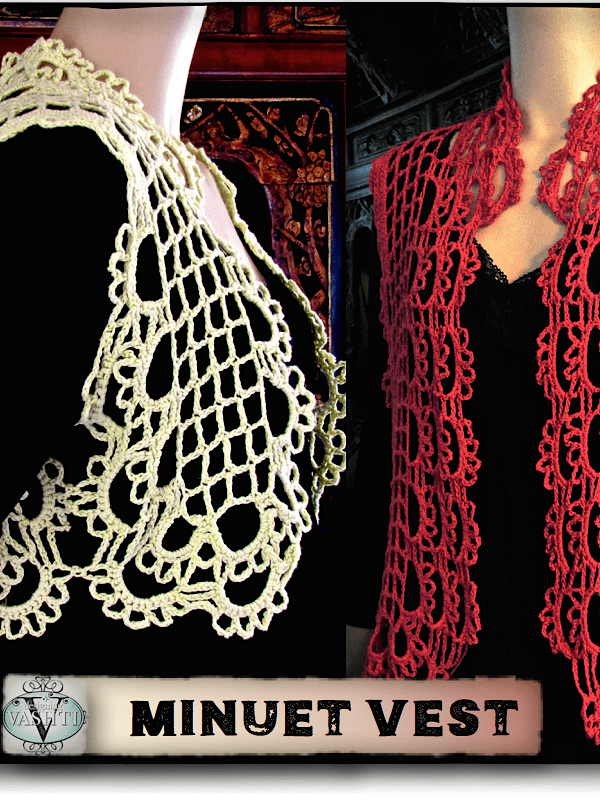
Minuet Vest pattern: regular traditional filet on the left, Tunisian filet on the right (red vest).

With just two skeins of a casual daytime cotton yarn, this summery vest can be thrown on over anything for a bold, modern lace statement. Use a polished fashion yarn, and the silky gloss suddenly takes the same design into an elegant Jane Austen-style world. The dramatic architecture of the lace is unforgettable over solid black. 

The basic idea of the Minuet Vest is this: crochet a simple shape, add a fancy border, then link up the sides to turn it into a vest. I chose plain filet crochet lace for the simple base shape so that it would be quick to crochet. Filet is also an easy grid for edging with a fancy border later. Chains and single crochets are the only stitches needed for the lacy scallop border.

This design won the Hookalicious award in 2010 from the Crochet Liberation Front.

Pattern Features

This pattern explains step by step how to use a type of Tunisian Knit Treble stitch for the filet, like I used for the red Minuet. If you prefer to use regular crochet stitches such as the treble crochet + ch-2 filet I used for the cropped yellow version, see this online article about adjusting the gauge of filet stitches.

Printer-friendly filet charts and edging diagrams are on the last pages of this pattern.

Skill Level

Intermediate to Experienced because of the join-as-you-go seaming. Over the years I’ve encountered crocheters who struggle with assemble-as-you-go garment construction. The struggle may be with how it’s described in text, so I’ve created visual aids for this step on the last pages. 

The skill level of the stitches is Intermediate due to the Tunisian crochet stitches used for the filet section. Experienced filet crocheters can substitute regular filet stitches following the filet charts on the last pages. The fancy scallop border requires only chains and single crochets. 

I’ve kept pattern abbreviations to a minimum and include International English equivalents for American terms.

?After using this pattern you will know (if you didn’t already):

  • How to construct a vest as you go, with a few crochet joins instead of seams.
  • How to let a fancy border do all the shaping.
  • How to use the same pattern to make a cropped bolero style.
  • How to crochet an easy, great-looking Tunisian Filet stitch variation.
  • How to adjust both stitch and row gauges of your filet crochet lace.
  • How to fine-tune a standard size for a Petite or Tall fit.

Materials

  • Crochet Hooks: Tunisian G-6 (4 mm) and approx. 10″ {25.4 cm} long; or size required for gauge. Regular crochet hook G-6 (4 mm) or size required for gauge. 
  • Ten stitch markers (for shoulders, corners, and side seam joins during final edging)
  • Yarn: Choose a yarn in the #2 Fine Weight category with a recommended crochet hook size range of US E/4 {3.5 mm} to US G/6 {4.0 mm}. These yarns may also be referred to as Sport or Heavy Sock {Light DK, 5-Ply}. For example, Patons’ Grace (100% mercerized cotton; green swatch in photo album).

Yarn Used for Tunisian Cherry VestDesigningVashti.com Lotus (54% Cotton, 46% Rayon; 256yd/234m per 3.5oz/100g skein): 1 ball (256 yds) for cropped bolero lengths of all sizes except Medium and Large; 2 balls (512 yds) for most sizes in the longer Vest length shown; 2 balls plus 1 smaller Lotus Snacks ball (600 yds) for Size Large Vest (has 3rd layer of Scallop edging, shown). 

Yarn Used for Key Lime Bolero: Universal Yarn’s Summer Linen (50% Linen, 50% Cotton, 126yd/115m per 1.76oz/50g ball): 2 balls (252 yds) used for Sizes Small and Smallish-Medium.

Finished Dimensions

How to choose your size: Make your vest any length you wish. This style is meant to be worn open and loose over other clothing, so even a close-fitting size will feel looser on (have more wearing ease) than it may seem from the measurements given below. 

For this pattern, the most important measurement is the width from shoulder to shoulder. The next most important one for fit is the chest/bust circumference. Each size has more than one finished bust measurement listed. It’s based on how many scallop rounds you add to the border. For example, the red vest has three rounds of scallops at the front opening (with a fourth for the collar), whereas the cropped version has only one round of scallops (with a second for the collar). Each round of scallops adds almost 5″ {12.7 cm} to the total circumference.

Sizes Teen 14-16 and XSmall

Across Shoulder when worn: 13″ {33 cm}

Finished Bust if vest is worn closed in front: 34″ {86.36 cm} with a border of two scallops would be a standard fit for a Size Teen 14-16, and close-fitting for an adult Size XSmall. 39″ {99 cm} with a wider border of three scallops would be a standard fit for an adult Size XSmall, and a very loose fit for a standard Teen.

Length: starts at 15″ {38 cm} for the cropped bolero style. Lengthen in 2.5″ {6.35 cm} increments easily with no limits; instructions are included in the pattern. Red vest shown is 22″ {55.88 cm} long. A knee length on a teen would look très Boho with boots and jeans!

Sizes Small and Smallish-Medium

Across Shoulder when worn: 15″ {38 cm}

Finished Bust if vest is worn closed in front: 37″ {94 cm} with a border of two scallops would be a standard fit for a Size Small, and close-fitting for a Size Medium. 41.5″ {105.4 cm} with a wider border of three scallops would be a standard fit for a Size Medium, and loose-fitting for a Size Small.

Length: starts at 15″ {38 cm} for cropped bolero style. Red vest shown is 22″ {55.88 cm} long. Lengthen in 2.5″ {6.35 cm} increments easily with no limits; instructions in the pattern.
Sizes Largish-Medium and Large. For a Plus Size 1X option, see Note under Finished Bust, below. 

Across Shoulder when worn: 17″ {43.18 cm}

Finished Bust if vest is worn closed in front: 39″ {99 cm} with a border of two scallops would be a standard fit for a Size Medium, and close-fitting for a Size Large. 44″ {111.76 cm} with a wider border of three scallops would be a standard fit for a Size Large, and loose-fitting for a Size Medium. Note: For a Plus Size 1X and 2X option, repeating the Scallop border a fourth time at only the sides would result in a finished bust of 49″ {126.46 cm}.

Length: starts at 17.5″ {44.45 cm} for the cropped bolero style. Red vest shown is 22″ {55.88 cm} long. Lengthen in 2.5″ {6.35 cm} increments easily with no limits; instructions in the pattern.
Posted on

Preview: Aery Faery Lacy Tunisian Crochet Scarf

I’m looking over the photos I’ve taken so far of my newest Tunisian crochet design. Lately, the weather here has created some moody lighting. Have a look at these!

Aery Faery Lacy Tunisian Crochet Scarf End
My first filet-like Tunisian crochet lace in opalescent mohair and silk.

I’m calling it Aery-Faery because it is faerie-like and diaphanous, like fairy wings. I’ve crocheted most of it while watching the first season of Once Upon a Time. In fact, I’m pretty sure the idea for this design first came to me while watching the show.

Aery Faery Lacy Tunisian Crochet Scarf/Stole
Scarf shown draped like a stole. It’s very stretchy!

The yarn is divine for a lacy Tunisian crochet scarf.

It’s Artyarns Silk Mohair Glitter; a strand of Lurex is plied with the silk and mohair. It’s particularly fine and smooth. The dyeing is gorgeous. You can’t tell from some of the photos, but it’s the subtle colors of a milky opal. The colors shift like they do in an opal, too.

The Aery-Faery pattern draft is done. I’m testing a variation tonight and have the final proofreading to do before sending it off for tech editing and testing.