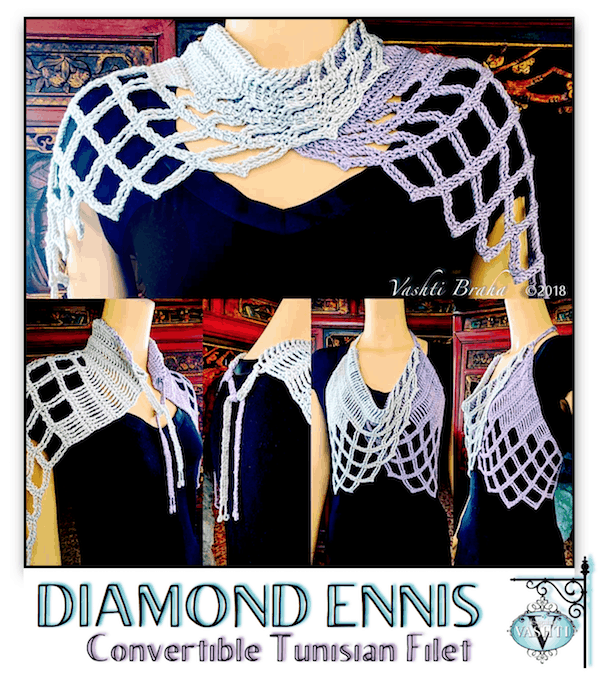
Diamond Ennis

This two-color convertible rhombus shape makes the most of one of my favorite things: Tunisian filet structure and drape. Looking for the triangle shawl? See the Ennis Revelation set.

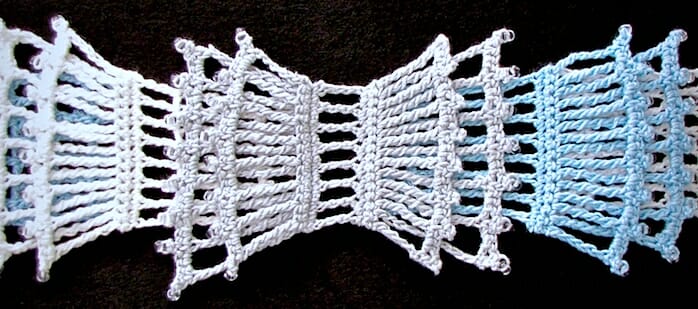
Add two beaded ties for a shoulder layer that stays where you drape it. Add two more ties and it converts to a stunning halter top.

The ties are designed to be repositionable. Add, remove, and relocate the ties anywhere, easily. They’re crocheted with Tunisian stitches and the beaded fringe ends are done with a crochet hook.

The size Small shown here required only 170 yards (two Lotus Snack mini-balls) and could be completed in a day. Tunisian lace doesn’t use up a lot of yarn, and looks pretty on both sides.

The pattern includes changes for Medium, Large/1X, and Plus sizes. It has a stitch diagram, schematic, and plenty of leftie-friendly extra information.

This Diamond Ennis pattern is also in a set called Ennis Revelation. The other pattern in the set is a triangular shawl that was my first and most dramatic Tunisian filet design, published as Ennis in Interweave Crochet Magazine, Summer 2013 issue.

The original Ennis inspired the Aero series: Aero, Warm Aeroette, Aery Faery, and Aquarienne, as well as more designs in progress, classes, newsletters, and blog posts over the years. I’ve added links to some of these in this pattern.

Skill Level

Tunisian Intermediate. With this pattern you’ll learn how to crochet a diamond shape from the center out. You’ll decrease along only the “easy” edge (the starting edge of the forward passes).

Is this your first Tunisian filet project? Try a few different crochet hooks; a different surface finish may offer more control when making stitches with many yarn overs. If the numerous yarn overs remain challenging, start with the Aery Faery or Warm Aeroette pattern instead. They were written with Tunisian filet beginners in mind.

I’ve kept abbreviations to a minimum.

?After using this pattern, you will know (if you didn’t already):

  • How to apply principles of filet crochet to Tunisian stitches for a strikingly lacy net.
  • How to manage different kinds of loops held on the Tunisian crochet hook: temporary vs. Tunisian yarn overs, and completed stitches.
  • How to make and drape a “diamond” (rhombus) as a capelet-style wrap, and halter top.
  • How to edge Tunisian crochet with filet spaces as you go.
  • How to crochet beaded-fringe removable ties.

Finished Dimensions

Measured flat, blocked. Dimensions are given for sizes X-Small/Small, with Medium and Large in parentheses. Pattern has more details on customizing the dimensions and yarn amounts.

  • Halter Vest: Torso circumference is 38 (41.5, 45)” {96.5 (105.4, 114.3) cm}. Each solid-stitch bra cup section spans approx. 7.5 (8.5, 9.5)” {19.1 (21.6, 24.1) cm} in height and width. Neckline drop is 12 (13, 14.5)”.
    The ties add range to these final dimensions.
  • Shoulder Drape: 38 (41.5, 45)” long x 12 (13, 14.5)” wide {105.4 (114.3) cm x 33.0 (36.8) cm}.

Materials

Straight or Flexible Tunisian crochet hook at least 13″ {33.0 cm} long: Size G/6 {4 mm} or size needed to match gauge.

Yarn DesigningVashti.com Lotus (52% Cotton, 48% Rayon; 256 yds/235 m per 3.5 oz/100 g skein): This yarn comes in two amounts. This one is the original 256-yd ball. See below for the 85-yd “Snack” mini-ball. Use one 256-yd ball if you want to make a one-color version in any size. For the 2-color version, use one ball of each color for the Plus sizes.

  • Yarn Used for Diamond Ennis Shown: DesigningVashti.com Lotus Snack mini-balls (52% Cotton, 48% Rayon; 85 yds/77.7 m per 1.16 oz/33 g skein): 1 (2, 2) balls each of Satin Grey and Lavender Ice. Add 40 yds more per Plus size (see p. 9) and use the 256-yd ball size listed above.
  • Substituting Yarns: Pattern works the same if you use one color throughout. The dramatic filet border is created as you complete each row, so a long-striping yarn would work well. Choose a yarn with a recommended crochet hook size range of E/4–G/7 {3.5 mm–4.5 mm}. Or use any yarn weight and a hook size that is appropriate for it.

Large Seed Beads and a steel hook (optional for ties): 18 seed beads per tie. Capelet style needs two ties (36 beads) and the halter style needs four (72 beads). The bead holes need to be large enough for a loop of your yarn to be pulled through with a steel crochet hook. For the Lotus yarn I used size 6° “e-beads” and a size 10 {1.3 mm} steel hook.

Notions: Two stitch markers. Scissors. Yarn needle.
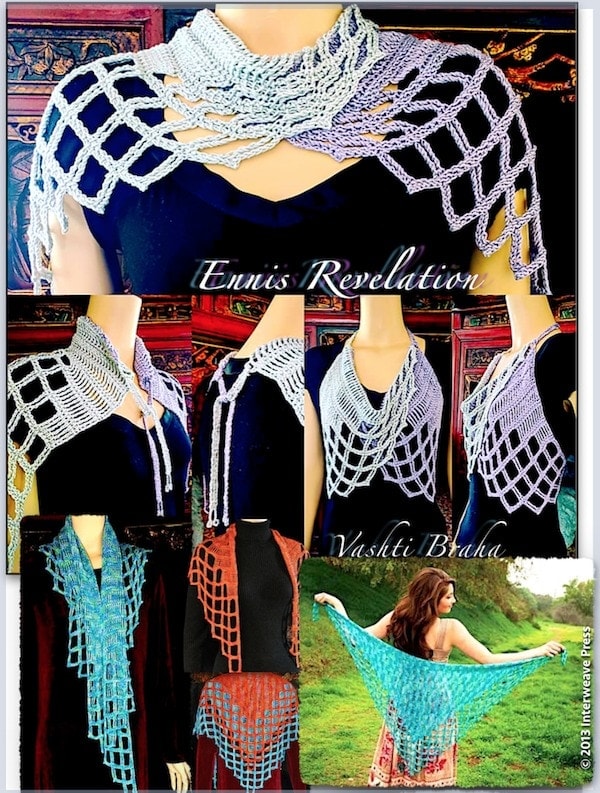
Ennis Revelation

The triangular Ennis shawl in this two-pattern set is my first and most dramatic Tunisian filet design. The four-sided lavender Diamond Ennis is the most recent. Triangular Ennis was originally designed for Interweave Crochet Magazine, Summer 2013 issue.

Also new for this set is a complete stitch diagram, schematics and plenty of extra information—for lefties too.

Back in 2010 I couldn’t find examples of filet lace done with Tunisian crochet. The original Ennis was my confirmation and encouragement—a revelation. I remember the liberating “Yes, it can be done!” feeling. It inspired the Aero series: Aero, Warm Aeroette, Aery Faery, and Aquarienne, as well as more designs, classes, newsletters, and blog posts over the years. I’ve added links to some of these in the patterns.

They’re lovely on both sides, which I find is typical of Tunisian crochet that is very lacy. Another nice feature of Tunisian lace is that it doesn’t eat up yarn. Even the orange one-skein Ennis can be tied around my medium-size waist on a carefree summer day. I used two skeins for the larger blue one, and two of my Lotus Snack mini-balls for Diamond Ennis. The pattern works with any yarn amount and weight.

Skill Level

Tunisian Intermediate. With this pattern you’ll learn how to crochet a triangular shawl side to side (a.k.a. point to point or P2P), and a diamond shape from the center out. You’ll either increase or decrease along only the starting edge of the forward passes. The dramatic filet border is created as you complete each row, so a long-striping yarn would work well for this.

I’ve kept abbreviations to a minimum.

?After using this pattern, you will know (if you didn’t already):

  • How to apply principles of filet crochet to Tunisian stitches for a strikingly lacy net.
  • How to manage different kinds of loops held on the Tunisian crochet hook: temporary vs. Tunisian yarn overs, and completed stitches.
  • How to crochet a triangle shawl by starting and ending at the upper corners.
  • How to create a versatile diamond variation using just the gauge swatch.
  • How to edge Tunisian crochet with filet spaces as you go.
  • How to crochet beaded-fringe removable ties.

Materials & Sizes

Straight or Flexible Tunisian crochet hook at least 13″ {33.0 cm} long: Size G/6 {4 mm} or size needed to match gauge.

Yarn DesigningVashti.com Lotus (52% Cotton, 48% Rayon; 256 yds/235 m per 3.5 oz/100 g skein): use one ball for the smaller orange wrap and 2 balls for the larger blue one. It’s currently available and substitutes perfectly for the (possibly discontinued) orange and blue yarn I used for the original triangle shawls:

  • Diamond-Ennis (170–240 yds): 38 (41.5, 45)” {96.5 (105.4, 114.3) cm} long and 12 (13, 14)” {30.5 (33.0, 35.6) cm} wide. For the one shown, I used only 1 (2) balls each of DesigningVashti.com Lotus Snack mini-balls (52% Cotton, 48% Rayon; 85 yds/77.7 m per 1.16 oz/33 g skein), Satin Grey and Lavender Ice.
  • Halter Vest: Torso circumference is 38 (41.5, 45)” {96.5 (105.4, 114.3) cm}. Each solid-stitch bra cup section spans approx. 7.5 (8.5, 9.5)” {19.1 (21.6, 24.1) cm} in height and width.  Neckline drop is 12 (13, 14.5)”. The ties add range to these final dimensions. Dimensions are given for sizes X-Small/Small, with Medium and Large in parentheses. See p. 9 for customizing the dimensions and yarn amounts.

    Shoulder Drape: 38 (41.5, 45)” long x 12 (13, 14.5)” wide {105.4 (114.3) cm x 33.0 (36.8) cm}.

Yarn: Southwest Trading Company Bamboo (100% bamboo; 250 yd [229 m]/3.53 oz [100 g]): 1 (#411 Tequila) or 2 (#128 Ocean Life) skeins, possibly discontinued:

  • Two-skein (500 yds) blue shawl: About 62” {157.5 cm} wide from point to point and 25” {63.5 cm} long at deepest point of triangle.
  • One-skein (250 yds) orange shoulder wrap: About 50” {127.0 cm} wide from point to point and 20” {50.8 cm} long at deepest point of triangle.
  • Substituting: Pattern works the same if you use one color throughout. Choose a yarn with a recommended crochet hook size range of E/4–G/7 {3.5 mm–4.5 mm}. Or use any yarn weight and a hook size that is appropriate for it.

Large Seed Beads and a steel hook (optional for ties): 18 seed beads per tie. Capelet style needs two ties (36 beads) and the halter style needs four (72 beads). The bead holes need to be large enough for a loop of your yarn to be pulled through with a steel crochet hook. For the Lotus yarn I used size 6° “e-beads” and a size 10 {1.3 mm} steel hook.

Notions: Two stitch markers. Scissors. Yarn needle.
Posted on 2 Comments

Tunisian on the Diagonal: Class Resources

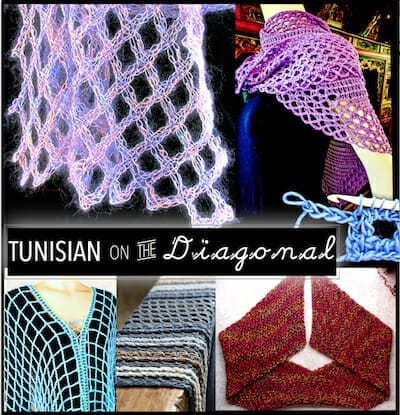
Official image for the 2018 Tunisian on the Diagonal class, Chain Link Conference, Portland OR
Final update of this page is in progress, please check backView the high-res image. This is a conveniently clickable group of things I mention and display in Tunisian Crochet on the Diagonal classes. I teach the next one on July 27, 2018 in Portland OR.  I show a huge amount of published and unpublished crochet designs in this class including new, never seen! Each illustrates the stitches and techniques learned.   — Vashti Braha


Thinking of signing up for this class? I wrote New Angle on Diagonal Tunisian, and newsletter issue #93, with you in mind.

Diagonal Tunisian Crochet Patterns

Recommended Issues of Vashti’s Crochet Inspirations Newsletter

Blogged It

Photo Albums & Inspiration Boards

Recommended Sites

All about the “Half-Hitch” stitch

  • Quick how-to video (Backward Loop Cast On is the same as a half hitch stitch.)
  • See the CAL discussion thread listed above.

Getting Geeky About the Geometry of Diagonal Tunisian

Any Books on Diagonal Tunisian?

Not that I’m aware of. Here are my three favorite Tunisian crochet references in print:

  • 2008: Tunisian Crochet Patterns 100, Nihon Amimono Bunka Kyo-kai, Japan ISBN 978-4-529-04484-4
  • 2000 (1991), Rebecca Jones: Tricot Crochet The Complete Book, Lacis Pubs., Berkeley CA. ISBN 978-1-891656-28-6
  • 2004, Angela “ARNie” Grabowski: Encyclopedia of Tunisian Crochet, LoneStar Abilene Pubg LLC, TX. ISBN 978-0-974972-55-8

The Five Peaks Tunisian Crochet Shawl design in the news & around the ‘net

I created this resource list for my students & others to explore the Five Peaks Tunisian crochet shawl, and similar start-in-a-corner, edge-as-you-go L-shaped wraps.

Inspiring Features, Examples, and Variations of the Five Peaks L-Shape

  • Doris Chan’s Fairlane
  • Nicky Epstein’s __
  • Barry Klein’s _

Yarn Tests for a New Tunisian Crochet Filet Design

How to Increase Tunisian Crochet Stitch Blocks

Preview: Aery Faery Lacy Tunisian Crochet Scarf

2010 CGOA Runway: Tunisian Weightless Wrap

Two-Color Tunisian Crochet Swatches

Tunisian Crochet Books for Research

How to Fix Loose Loops of Tall Stitches

Pictured above: Cantina in beaded Lotus. Also see triple trebles in the Dessert Party Apron.

When tall stitches look very different from each other, or lumpy, stringy, loose, or too short, we just need to take more control of them. Especially vexing is when the top loops look loose and loopy! My solutions below will help you crochet even the very tall stitches that look downright handsome. First, some basics of crochet.

Tall & Taller Crochet Stitches

A basic rule of crochet is if you already know how to do the double crochet stitch (US: dc, UK/AUS: tr), it’s easy to understand how to make the taller ones. Here’s how to crochet the dc into a row of stitches:

Yarn over and insert your crochet hook under the top two loops of the next stitch of the row. Yarn over and pull up a loop; you now have three loops on your hook. *Yarn over and pull the loop through two of the loops on your hook, then repeat from the * once: only one loop remains on your hook.

An amazing feature of crochet is there’s no limit to a stitch’s height. Start with the double crochet stitch as the model for crocheting any taller stitch. Here’s how to make a treble, the next taller stitch:

Yarn over two times (instead of once for a dc). Insert your crochet hook under the top two loops of the next stitch of the row like you would for a dc, yarn over and pull up a loop; you now have four loops on your hook. *Yarn over and pull the loop through two of the loops on your hook, repeat from the * until only one loop remains on your hook—for a treble, that’s twice more.

With each taller stitch (double trebles and so on) you yarn over more times and then work the loops off of the hook in pairs, just like you do to make a dc and tr. The only difference is that you have more pairs of loops to work off.

What About Tall Stitch Variations?

Aquarienne Beach Cover Up breaks the usual Tunisian crochet pattern conventions
Aquarienne has very tall Tunisian crochet stitches.

Note that I’m sticking closely to the basic stitches here. That means I’m leaving out:

  • other types of tall stitches, such as the extended ones of half-step heights,
  • other ways to add loops to the hook, and
  • more ways to crochet them into other stitches.
  • Also, tall Tunisian stitches.

These non-basic stitches have the same problems with loose top loops. My tips below will help.

A Better Start

Our goal is no slack in our loops beyond what’s needed for crocheting at our normal smooth and easy gauge. This is not about crocheting tighter. It’s about identifying where we let extra yarn creep in.

Buff your crochet hook surface.

Even slight, imperceptible residue will cause you to need a bit more slack in your loops. For a few seconds I vigorously rub the whole stitch-making zone of the hook with a soft cloth (preferably microfiber or chamois). I do this when I start a new project, resume crocheting one after a long break, or daily during peak summer humidity.

Adjust the initial loops.

The loop that’s already on your hook will become the top two loops of the new stitch. I tug on it gently to tighten. The loop should still slide freely along the main part of the hook (not the narrower tapered neck of it).

Let’s start a triple treble (US: trtr, UK/AUS: quadtr). I yarn over four times and immediately slide all the loops together while tugging a bit on my yarn. This removes unnecessary slack. They should still slide well on the hook as a neat, snug group. Keep your thumb or forefinger on the group so that they don’t loosen as you start crocheting.

It’s easy to overlook how much extra yarn we add to a stitch if the yarn overs spread out along the hook. (Keep this in mind for lacy Tunisian crochet too!) This will become a quick automatic movement after a while.

Better Stitch Making

While working the loops off of my hook in pairs, I pull up a bit on the loops. This has two benefits.

Lifting adds elegance.

If you think of the base of a stitch as having two “feet” planted in a stitch, then pulling up a bit higher while working the stitch creates longer “ankles” and a streamlined body. I first learned this about the dc from Pauline Turner in her Crocheted Lace book (Martingale, 2003). She explains why even experienced crocheters can have trouble getting a doily to lie flat if their stitch heights vary from the designer’s.

Lifting while making your tall stitches will help you get row gauge for filet lace projects. Feel free to add a chain to your turning chains if lifting makes your row a whole chain taller.

Use the “reserve” yarn.

Not all of the yarn is coming from the ball of yarn to complete the stitch. Some comes from the “reserve” yarn that’s wrapped around the hook. As I crochet I’m almost miserly about the yarn coming from the ball as I pull up a bit, yarn over, and pull through two loops at a time.

Try it: go slowly and watch how more yarn gets pulled off of your hook if you restrict the flow of yarn from the ball.

Part of this motion is that I’m also tilting my hook at a sharp angle. The head is pointing almost straight down as I pull a loop through the next two loops on the hook. This helps the yarn slip from hook and into the stitch at a pretty angle.

The stitches comes out uniformly neat and orderly looking. These subtle crocheting adjustments will become automatic and feel natural.

The Yarn Matters

Crocheting a tall stitch involves a lot of wrapping. A right-handed crocheter wraps the yarn around the hook in a counter-clockwise direction. It either untwists a yarn, or adds more twist, depending on whether the yarn starts out with a clockwise or counterclockwise twist (a.k.a. “S-twist” or “Z-twist”).

This is really noticeable sometimes. The tall stitches look stringy or uneven for several reasons:

  1. It’s hard to work the loops off the hook evenly without splitting the plies of yarn.
  2. A yarn flattens when it loses twist. This affects how the stitch looks.
  3. Separated yarn plies add a stringy look to the surface of a completed stitch.

The fiber blend matters. Slippery yarns add challenge, and so do yarns with uneven bumps. Sometimes trying different crochet hooks helps (remember to buff them first).

When you’ve tried everything, it’s not you. Occasionally, tall stitches are going look looser no matter what you do! Blocking might help.

Tall stitches love a good blocking.

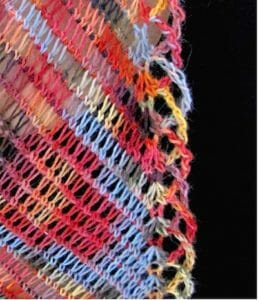
Close up of an edging of tall stitches along the diagonal edge of a triangular Tunisian shawl.
Tunisian Islander Wrap with a lattice edging of tall stitches.

This probably sounds about as fresh and exciting as “take time to check your gauge” but the transformation is so worth it.

Tall crochet stitches are structurally complex. Blocking gives the yarn strands a chance to absorb the energy you added with all the wrapping and looping, and to meld evenly into a stable column.

Your tall stitches will respond even more handsomely to blocking if your yarn does. Natural fiber content helps because it responds so readily, but you can also block some 100% acrylic yarns with steam very carefully.

Crochet’s lacy beauty really shines through with the tall stitches, doesn’t it? I fall in love with crochet all over again when I use them.

Inspired by the release of the Tokyo Jacket, an earlier version of this material was posted October 2, 2009 at an older blog.

How to Block Crochet Five Ways

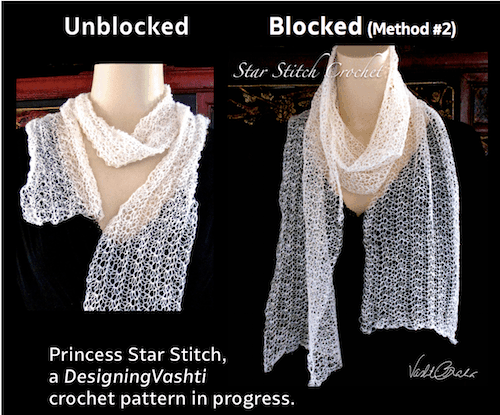
An antique, translucently lacy star stitch before blocking and after.
View the high-res version of the above image.

Some of us only use one or two of these five, but you may discover that you use more blocking methods than you thought. (I hope we all use at least one!)

One of the methods below could be the perfect finishing touch for your next crochet project, depending on your yarn and project type. They’re listed from the gentlest to the most aggressive. It also depends on your own preferences. I’ve found that each crocheter has a favorite method.

Special considerations for a specific stitch, technique, or project follow.

1. Dry Block (the gentlest method)

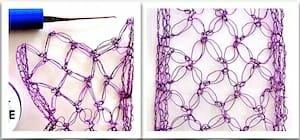
Love knot mesh crocheted in wire always needs to be "fluffed up" manually. I use a crochet hook to do this.
On the left, love knots crocheted in wire are “unblocked”. On the right I’ve manually “dry blocked” them using a fine crochet hook to open them up.

I also think of dry blocking as “hand ironing”. Crocheters do this without even knowing that it has a name. Stretch, spread out, and flatten your crochet piece on something flat. One’s knee always seems to be nearby! Using one’s knee or upper leg is not too bad for a small item, especially if you’re wearing jeans or other fabric that provides a bit of friction. (Don’t use it for measuring a gauge swatch though.) If your surface is hard and flat, such as a table, you can also press it with your hands, i.e. “hand-iron” it.

I’ve read that some crocheters prefer the softer and more handmade look of their thread lace when they dry block it only. (Wet blocking thread crochet is more common, and it can include a stiffener; see below.)

Isn’t wire crochet a great way to illustrate dry blocking?

2. Damp Block

Also known as spray blocking and blocking with mist. Spritz liberally with water, especially the edges, then spread out on a toweled surface to dry. Use a bath towel on a flat surface; the towel offers some friction that I find in most cases replaces the need for pins.

This method is my personal favorite. I blogged about it back in 2010. I also combine it with methods 3 or 4 below: usually I damp block every 6″ to 12″ of rows while I’m crocheting, and then do a final wet block when you’ve completed the project. I like damp blocking partly because it’s the most portable, and partly because it’s fast. It works great for the types of yarn I tend to work with: bamboo, rayon, and plant fibers in general; also merino and alpaca. For most of the year here in humid Florida, wet things simply take too long to dry. 

3. Wet Block

Wet blocking is when you fully immerse the crochet item in water. It’s a simple method that has several options for adding a whole range of effects to your projects. Practice wet blocking and it will develop into an art form. Try adding a fragrance, conditioner, fabric softener, or a stiffener to the water.

Depending on the yarn fibers and colorfastness, soaking can be a benefit or a liability. You can soak plant fibers like cotton, linen, hemp, rayon in warm or cool water a bit. This is Doris Chan’s favorite method.

For wools, immerse briefly in cool water to avoid fulling (felting), then remove excess water gently before spreading out on a toweled surface to dry. I like to add a little hair conditioner to the water if the yarn is wool or silk.

ShamWow super absorbent microfiber cloths are really helpful for speeding up the drying. I use them instead of, or on top of a bath towel on a table.

4. Steam Block

Steam blocking specifically uses the power of moist heat. This method can really pay off if you carefully test first. With practice you’ll develop the visual and tactile cues for how close to hold the steamer to your stitches and for how long, depending on the yarn. You’ll also develop a sense for which effects to aim for with a given yarn and stitch pattern. 

Why risk using this rather aggressive blocking method? It can give acrylic yarns the sheen and drape of silk. Steam blocking is an art that can bring out extra softness and luster in some silk, camel, and llama fibers too.

5. Pin Block

Pin blocking includes stretching an item on blocking wires while wet or steamed. The most important thing about pinning is to use rust proof pins. I don’t own blocking wires, but I sure admire the knitted lace wraps that have been blocked with them. (Personally and non-professionally, I have only ever pinned crocheted snowflakes.)

Special Blocking Considerations

You might enjoy this newsletter issue about the art of blocking crochet. 

Picots 

Tug and pinch each picot to round it out and make it visible, adding more water to them than the rest of the stitches, if necessary. Sometimes I roll each picot between my fingers to compress them and even out their roundness.

Love Knots

Most love knots are intended to be air-filled like a semi-inflated balloon. If yours are, spritz lightly with mist and damp block selectively: stretch and flatten stitches around the love knots. Gently smooth the love knots themselves so that you don’t flatten, deflate, stretch them out, nor weigh them down with too much water. You might feel like it’s not worth blocking them at all, but I tested this in my love knot classes and people could tell the difference.

Conversely, if you want yours to have the limp and collapsed look that is typical of the love knots in the tropics, feel free to wet block and perhaps even steam block them.

Lacy Tunisian Crochet

Class: Tunisian Eyelet Meshes (Crochet Meshes: The Weightless Wrap & Variations)
Blocking Weightless Wrap

The lacy Tunisian crochet that I’ve done responds beautifully to wet blocking. Aim for squared filet eyelets. I tug strongly on the return pass lines to straighten, flatten, and lengthen them evenly. Tug vertically on extended Tunisian stitches to fully extend them, if you used them. 

Garments

Wet blocking is the method here for the stylish fit, silhouette, and elegantly flowing, breezy movement many garments and accessories are intended to have. It’s no wonder that it’s Doris Chan‘s favorite method. Be sure to block the accessories that need to drape stylishly, such as wraps, scarves, collars, and even necklaces.

If you used acrylic yarn, steam blocking can bring out all the fashion drape and gleam, as if you used silk! 

Note that steaming some animal fibers will soften them enough to wear against the neck.

Home Decor

Home decor projects, especially doilies, snowflakes, and afghan squares (also flowers and other appliques) usually need to be as perfectly flat and square, or round, as possible. Wet blocking with pins, wires, or dowels is common with these items. Sometimes starch is added (especially for snowflakes). 

And finally…for all blocked items by all methods:

Let air dry completely, then admire your work and bask in the compliments!

This is a revised version of an earlier (October 2014) blog post at Vashti’s Crochet Pattern Companion. It also forms the basis of a chapter I wrote for the Crochet Guild of America’s Fundamentals of Crochet Masters Program.